| Peter Upton's |
Subbuteo Tribute Website. |
The Boxed Editions |
|
Page 1: British Editions 1947-1969 |
These pages are an attempt to show the full boxed editions of eleven-a-side football produced by Subbuteo. It's that straight forward really. Once again, if anyone has information that will help with this page, I'd love to hear from you. This page is full of large jpgs, so expect it to take a little time to load. If you want to see the contents of these sets, I strongly recommend that you visit Chris Smith's Subbuteo365 website. This site shows the 1960s and 1970s sets in all their glory.
1947-50 The Early Editions.
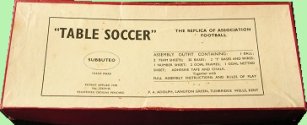
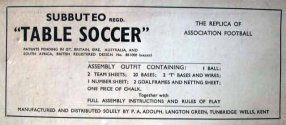
Subbuteo's original box set was called the "Assembly Outfit". It was a very primitive set put together by Peter Adolph, with help from his mother. It sold via mail-order, and the first sets were sent out in March 1947. The set came in a red box, about the size of a 1960s team box, with details written on a brown panel on the lid. It featured a dark brown celluloid ball, two team sheets of cut-out card players, twenty patented plastic bases (made from Woolworths buttons), two "T" bases with wires for the goalkeepers, two flat packed metal wire goal frames (with paper nets), a number sheet, and a piece of chalk to mark a pitch onto any available cloth, preferably an old green army blanket.
The small scale nature of the business allowed changes to be made quickly, and Mr. Adolph continued to tinker with the set after launch. This was understandable, as he had originally advertised the game for sale whilst he was still inventing it. This means that there were slight differences in the early sets, and three different boxes are now displayed here. The box shown left seems to be the earliest. Table Soccer is clearly stated but the word Subbuteo was only in a small oval underneath, looking like an afterthought. Under the oval are the words "trade mark". On the box shown right, the word Subbuteo had increased in size, and was placed more prominently. On this box Adolph also advised that patents were pending in Gt. Britain, Eire, Australia and South Africa, and that his new improved bases were a British registered design. The contents read the same as the earlier set. At some point in the Autumn of 1947, the "button type" bases were replaced by the more familiar style of base, which were originally called "super flattened bases".
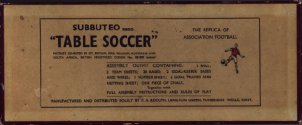
The third version shown is a 1949-50 set. The lid was identical to the previous version in layout, but the obvious addition was a logo of a kicking footballer. On the contents list, the "T" bases were replaced by "goalkeeper bases", which means that the goalkeepers had swapped to standard bases at this time. Inside the set, the players became press-out card instead of cut-out. There was a nice catalogue/list in this set, showing the arrival of celluloid figures. Everything was becoming more professional and standardised. At this point, Adolph reached full time production.
| Assembly Outfit: | The original set with ball, two team sheets, 20 bases, 2 goalkeeper bases and wires, one number sheet, 2 goal frames and netting sheet, and one piece of chalk The players were cut out, or press-out cardboard. |
The 1948-49 price list mentioned a "New Super Assembled" Subbuteo set, complete with marked out pitch. However, "owing to the difficulties of the times" the set was restricted to "exports abroad and for Educational Purposes in the UK". You had to be some form of instructive organisation to buy one, and had to write on "official headed note paper". Examples given were schools, football clubs, youth clubs, and boy scouts/boy's brigade. No price was quoted, and no bigger sets were mentioned in any of the other accessory lists until the 1953-54 season.
For more details of the early days, there is now a Subbuteo in the 1940s page.
The Early 1950s "Red Box" Editions.


By 1953, Peter Adolph was producing three different versions of his football game for three different budgets. (As well as cricket, rugby, and racing games, which are dealt with elsewhere on the site). This meant the standard box set could no longer be called Set A. This small original set was renamed the "Popular Outfit", and was given an attractive orange and black label to match the larger sets (although the red box remained the same).
A step up from this was the Combination set. This still lacked a pitch, but had celluloid teams, and the deluxe metal goals (set N) which came ready assembled with real nets rather than paper ones. This was originally sold in a small square box - if you imagine two deluxe goals side by side, then that is about the size of this set, as illustrated. It meant the paperwork had to be folded in half a different way to fit the box.
Top of the range was the Super Set. This was supplied with a pitch, and had the players already assembled and displayed for the first time. This was a lovely looking set, but the pitch made it very expensive. The original prices in 1953-54 were 10/1 for the Popular Outfit, 20/1 for the Combination, and 46/8 for the Super Set. That was increased to 48/8 by the following year. Despite that, the big set obviously sold well and is reasonably common in collecting circles. My picture here just shows the label. The box and lid are actually longer, as can be seen on the Super Seniors picture shown below. I've also illustrated the inside of a Super set just to show how nice a set this was
The action picture used on the box lid in this era was from a Great Britain vs. Rest of Europe game played in 1947. It was also used on the first issue of the bulletin for the Table Soccer Players Assn, where Peter Adolph describes it as "Parola (Italy) watches anxiously as Da Rui (France) gets to the ball at Lawton's feet". (For the record, Great Britain won 6:1).

In addition to the standard sets, there was also a Super Seniors set with an extra layer featuring many of the items from the A-Z range. This seems to have been a combination of Super Set, and the basic accessory outfit (Set A mark 2). (Not all the equipment in the above picture is part of the set of course).
January 2023: 1950s expert Luca Genzano was excited to get the Super Seniors set illustrated as he'd never seen it with the red box lid. Nor had I, but I had to admit that I've only seen pictures of two of these sets previously, which wasn't a big sample. Having the sets with two different lids suggests either a longer period of production than we suspect, or perhaps production during the changeover period between boxes (see below). The Super Seniors does not appear in any of the usual Subbuteo catalogues, but was seen (not illustrated) in one advertising brochure. The box lid is the standard one, so technically they could be swapped over.
Popular Outfit: |
This was the Assembly outfit going by a different name, with 2 flat card teams, goals and balls. |
Combination: |
With flat lightweight plastic printed teams, goals and balls. |
| Super: | Combination set plus playing pitch. |
Super Seniors: | Not in the catalogues, this was the Super set plus the basic accessory outfit that included sets FF, P, Q, R, T, V, Y and probably Set Z (early version). |
Mid 1950s-1962 "Blue Box" Flat Editions


This was a later 1950s re-box. Again, the boxes were red, but the tops/labels were altered to an attractive blue (with white sides featuring the product name and logo for the first time. These sets saw a new improved kicking logo, which was used extensively in the 1960s. As before there were three sets in the catalogues.
The Super Set shown here is of an earlier date than the other two, and you can see that more colour was added to the box, and football illustration in the later sets. Amusingly, the two players in the illustration were given red shirts, although they were rivals in the original picture. The inside of the set remained the same as the "red box" version.
For this range, the combination box was extended in length, so it looked like a smaller version of the aforementioned Super Set. This larger box gave a better unified feel to the range, with the step-up in size more clearly defined between the two smaller sets. The bigger combination received a label to match the Super Set. The new size allowed paperwork to be added without folding (useful with regard to the thick Advanced Table Soccer booklet). It also matched the size of a similar set produced by rivals Newfooty.
The blue box sets lasted until around 1962, when the new OO scale sets were first introduced. The flat editions then moved into green boxes to match the new sets. Before that, the Subbuteo goals switched from metal to plastic. Set N switched to plastic on the 1959-60 price list, so I would suggest that the sets switched at the same time. Whilst the combination, and Super Sets were issued with the standard plastic Set N, the popular set had to put up with a pair of cheap all-plastic goals, which were narrower than the ball. Despite the small size of these goals, the Popular set gained a deeper box, so that they would fit.
Sets have also been sighted with the referees (set P) included.
Super Seniors Set (Blue Lid).


Here is the "blue box" edition of the rare Super Seniors set. The pictures are of the two different sets I've seen, showing the set open and closed. The middle picture shows the one appearance of the set (that we know of) in Subbuteo literature. This was brochure that Peter Adolph sent to prospective Subbuteo owners, and it included an order form (he also did cricket, Speedway and Space versions). Interestingly, you can see a similar leaflet among the paperwork of the set shown on the left. However, this is the earlier version of this brochure, which features the red box editions (with no mention of the Seniors within). This does at least back up the theory that this set appeared in the cross-over period (note that the blue set has the early lid).
Supplied with the standard lid, this set came in a deeper box, with individual card trays packed with goodies. Thanks to Ashley Hemming, who not only sent in the pictures of this set, but spotted it named in the old piece of Subbuteo literature.
Popular Outfit: | Same as before |
Super Seniors: | Same as the red box version, this was a Super set plus the basic accessory outfit that included sets FF, P, Q, R, T, V, Y and (judging by this picture) the early red version of Set Z. |
1960's "Green Box" flat editions


Despite the arrival and success of the OO scale Continental Editions, the flat sets were still offered as a cheaper alternative throughout the 1960s, and the Combination and Super Set were still offered on the 1976 price list. These final versions of the flat era were re-boxed to match the 1960s continental sets, and again used the plastic goals from those sets. The Popular Outfit box changed size again, becoming shallow once more, but with an increased width to allow for the goals, and to save the paperwork having to be folded to fit the box.
Popular Outfit: | With cardboard teams, goals, balls etc. This budget set has a very small flat box, and featured very cheap all-in-one plastic goals which were too narrow for the ball. Price 10/9 |
With flat lightweight plastic printed teams, goals, balls etc. Price 19/11 |
|
Combination plus pitch. All in a lovely display box. Price 49/11 |
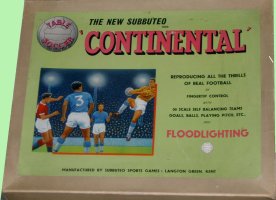

The Continental range started with an announcement in the 1961-62 catalogue that OO scale teams and floodlighting were "available from September". The first Continental box set included both these items, and was dated October 1961. Interestingly, no club or display editions were advertised until 1963, so the OO sets started as quite a deluxe option.
Shown above is the original Continental set. The first difference compared to the usual 1960s version is that the green colour is restricted to the centre of the lid. Like the 1960s accessory range there was a white surround, and the sides were also plain white. Inside, the inserts were a pale green (matching the green Super Set shown above). The teams were the original early heavyweight design, rather than any of the moulded figures that were used later. The goalkeepers were also an early version, with the moulding rather less defined. I have also seen early Display editions that feature the original heavyweights in red and blue, and it would be interesting to know when the moulded players actually first appeared.
Many thanks to Ashley Hemming, who sent in the details, and pictures of this important original OO scale set.


The OO scale sets of the 1960s slowly increased to the full range of four sets, with editions for every budget produced. These were successful enough that the standard range varied little from these sets for the next decade. In 1967, a display edition cost 28/11, a club set was 59/11 and a floodlighting set 89/11. When the international set was introduced it was 119/6.
Display: | |
The 1970s editions now have a page all to themselves. Just follow the link to the next page in this list.