| Peter Upton's |
Subbuteo Tribute Website. |
|
Subbuteo News |
|
Table Soccer Production in the 21st Century. |
After several years of neglect at the end of the 1990s, the new century has seen renewed interest in Subbuteo. New rumours seem to be forever flying around regarding production of the game. This page is designed to list the new box sets, teams and accessories to be released by Hasbro, Edilio Parodi,or anyone else.
There have been a couple of false starts already. Hasbro's new range of 2001 was small, exclusive to Toys-R-Us, and seemed to lack any support at all. In 2002-03 it was the turn of Subbuteo's old Italian importers Edilio Parodi. They produced an attractive box set, backed by a large range of teams and some interesting accessories. However, the production seemed relatively small-scale, perhaps inevitably based on the fact that the teams were hand-painted. My Italian friends tell me that the box sets sold out pretty quickly in Italian toy shops. Trouble was, they were not seen very often. Then 2005-07 saw the release of Hasbro/MB Games "photo-real" Subbuteo. A bold reinvention of the game, that in the end pleased nobody.
In 2009 - real Subbuteo made a return, with a weekly
Italian part-work, and a new limited edition box set at Marks and Spencer.
2012 - Subbuteo use another of it's nine lives, launching once again into UK
toy shops -
2014 - A second Subbuteo partwork launched in Italy - called the
"vintage edition" it features a replica heavyweight style figure.
2015 - Another "retro" edition set in UK shops - this time it is John
Lewis.
2018 - A third Subbuteo partwork in Italy.
2020 - The Subbuteo license holder changes to Longshore. And UK
distributors become University Games.
Hasbro.
As mentioned in my Subbuteo history, large US games company Hasbro became the producers of Subbuteo when they acquired previous manufacturers Waddingtons in 1995. Sadly Subbuteo at this time was under pressure from falling sales, and Hasbro's initial period in charge of the game saw a steady fall in the number of items and teams produced.
Hasbro finally announced that it was pulling the plug on production in January 2000. This created a backlash that seemed to catch Hasbro by surprise, and also kick-started Subbuteo as a collectable. Hasbro reversed their decision, and eventually produced a new range of three box sets and ten teams. This range was sold exclusively through Toys-R-Us (and Hasbro's own website). This small scale distribution, coupled with bad timing (arriving in some Toys-R-Us on Xmas Eve 2000) and a lack of decent advertising, meant that the new range didn't set the world on fire and it was quietly dropped.
However, 2001-03 saw Hasbro become interested in Subbuteo as a brand. It is after all, a recognizable and well loved football related "name" especially among the high income thirty-something bracket. They began to licence the logo on a diverse range of products such as clothing from Next, mobile phone games, pub quiz games and suchlike. Items of interest include:
Then there have been drink glasses, mugs, flasks, some rather attractive cuff-links, playing cards, and even a full size 1950s style rattle.
See Promotional and cross-selling and especially 21st century branded products for more details of items from this period.
As mentioned above, the game itself was also licensed to Edilio Parodi in Italy 2002-03, then bought back in-house for the "photo-real" version of 2005-07, then licensed once more in 2009-11 to Fabbri Editori for an Italian magazine partwork (and to Marks and Spencer for a box set). The game was licensed by Netcam of Spain in 2012, and their products ran alongside the Fabbri partworks. Towards the end of the decade, Fabbri Editori became Centuria, and Netcam seem to have become Eleven Force.... and then in 2020 it was announced that the new licence holder would be a Hong Kong based company called Longshore.....
Longshore/University Games Version 2020 onwards.
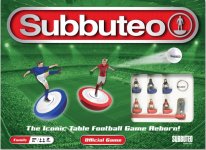
Although the marketing is telling us that this is a new era of Subbuteo, under new brand owner Longshore, it is useful to compare the box lid of the new "official game" version with the Paul Lamond "Team Edition" released in 2012 (below). It's the same logo, it's the same players and it's the same stadium picture. The ball is at least flying off at a different angle... It is not a surprise to learn that UK distributor University Games is related to 2012 distributor Paul Lamond Games.
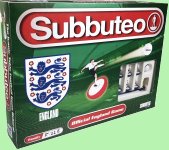
Still, the reboot has allowed the set to get back into retail shops rather than just online, as large toy shop chain Smyths are stocking the basic set. At present there are two different editions to buy, although they are the same price (£39.95). There is the standard official game - a new Club Edition in essence, with teams in the traditional red/white and blue/white. Then there is an Official England Game, where one of the teams is in a proper England kit, complete with "three lions" badge (something the Paul Lamond versions never managed). The England teams is available as a single boxed team (again, in the manner of the Paul Lamond boxed teams shown below). The official price of this team seems to be £12.99. So children who buy the basic version don't have to miss out. Hurrah.
Longshore Products 2020 onwards is my new page showing the Longshore products as they appear.
Longshore are planning to launch Women's Football products. Keep an eye on the site for more developments.
Netcam/Paul Lamond Games Version 2012-20.
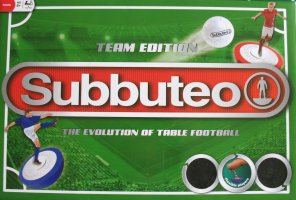
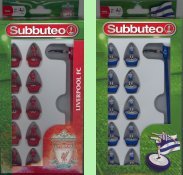
Introduced at the London Toy Fair in January 2012, and available in the UK in March 2012, this is the latest attempt to put Subbuteo back into toy shops, and into the hands of the next generation of football mad children. The range is Manufactured by Spanish company Netcam Iberia Valores, who also produce the Total Soccer game (see details below), and FT Champs. In the UK and Ireland, the game is being distributed by Paul Lamond Games Ltd.
The initial range comprises of a standard box set, a selection of teams, and a couple of accessories. The box set seems to be priced between £35 and £45, and the teams are around £10-£12.
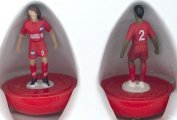
The teams are split between officially licensed club sides, and more generic colours. This is a good way to get a nice sized team range produced without having to pay all the license fees that seem to come with the modern game of football. The licensed teams so far are Manchester Utd, Liverpool and Chelsea, Manchester City, Arsenal and Tottenham, as well as Celtic and Rangers in Scotland. Both Chelsea and Liverpool featured updated versions for the 2012-13 season.
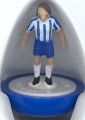
The non-licensed teams include blue and white stripes with blue shorts (Wigan, Brighton, Porto etc), red and white stripes with black shorts (Sunderland, Southampton, Athletic Bilbao etc), and black and white stripes with black shorts (Newcastle Utd, Notts County etc). The accessories include balls of course, and a referees set that has been acquired from the Total Soccer range.
The main differences between this modern Subbuteo, and earlier versions are the bendy players (the box calls them flexible), and improved levels of detail. Both the bendy players and great details are carried over from Netcam's Total Soccer. However, the figure here is different, being based even more obviously on Stefan Corda's 2K4 figure (apparently without permission). The bendy figure is designed to be less breakable than hard plastic figures, which is a big plus. They are produced in flesh coloured rubber, and the base around the feet is painted white.
Bases: - These are a new two part base, with two Subbuteo logos on top carrying forward an old tradition. It does mean the name and badge details of Total Soccer bases are missing though. The fit of the base is very much in the lightweight mode, but the shape is a nod towards the newer style of table soccer. It therefore has a lower profile, and large flat bottom designed for sliding, although swerve is also mentioned on the box. The general size and shape of the base does conform to the Hasbro bases of the late 1990s. So a bit of swerve would be possible, but not all that easy to perform. It's a bit of a half-way house.
It has to be said, that the fit of the base parts and figure are not always as good as I might like, but the players are not glued into the bases, meaning that you can take them out to clean up the pegs (or place them into "professional" bases if that is desired).
Team Box: - I rather like the exterior of the team box.
Again based on the Total Soccer box, they are robust with a good window to
display the team and bright attractive colours. The downside is the box
interior. It is made of a horrible thin white plastic, already breaking on one
of my sets. It is designed to hold the players securely, but instead, it makes
them too difficult to remove - goodness knows how kids will manage. To make it
worse, the slanting back of each section makes the players lean forward in an
alarming way. Okay, so they are quite flexible, but I'd be worried that they
wouldn't straighten out, and little hands may be tempted to over flex them. In
addition, I'd be worried that potential buyers familiar with old Subbuteo might
be put off buying the teams if they see bent players - damaged ankles was a
curse of the lightweight figure, and it is ironic that the new figure is
designed to overcome this, yet looks bent in the box, and it feels like you are
breaking the players just getting them out. Total Soccer had a nice
robust box interior, so it is sad that this hasn't been carried forward.
2013 - Very pleasingly, the second year of team production featured a
much better box interior.
The goalkeeper shape matches the lightweight 'keepers of the
1980s, with a bar fitting. Again, he is in a flexible rubbery plastic. Will this
bend with shots?
I don't want to be too critical here, because this is
essentially a traditional looking Subbuteo, with a bit of modern glamour. I'm obviously hoping it introduces a
new generation to the wonders of Subbuteo.
The game launched in other European
countries later in 2012, with different ranges of country specific teams.
Some importing may be required by the dedicated collector.....
2015 - The official team range expands into Europe, with Real Madrid,
Barcelona and Paris St Germain (individual teams and box sets).
The new box set is road-tested on the
2012 Subbuteo Team Edition page.
July 2013: a Netcam Subbuteo page has now been
started.
See the full range at Mad-About-Games or alternatively
Jaden Modelworld.
The SSE Women's FA Cup Final Limited Edition Set 2018.
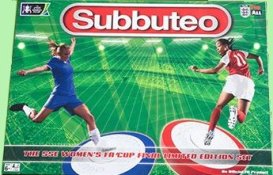
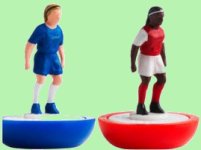
This set arrived with a large amount of promotional activity, with big articles and pictures in many of the national newspapers (during my website hiatus). The set was based on the Women's FA Cup final of 2018 between Arsenal and Chelsea, and the teams were painted (and indeed modelled) to match. The box is lovely, and the whole thing is beautifully put together. The FA said "This new, all-female Subbuteo set is a reflection of the rapid growth that women's football is seeing in the UK right now. We aspire to greater equality all the way from board games to boardrooms..." The advertising campaign won awards.... essentially for a set that didn't exist commercially.
Sadly, the set was a Limited Edition and the FA wasn't kidding in this. It was not available to buy, and indeed the figures were pain-stakingly hand modelled and painted. The time and expense of that ensured that only a few sets were produced, and these were only available as prizes in an FA competition. I can't help thinking that all that award-winning national promotional work went completely to waste. If young girls wanted this set to play with, they weren't going to be able to get one. The normal Subbuteo of the period wasn't being pushed at that time either - so if the girls decided to settle on a "boys" version, that wasn't exactly easy to get either.....
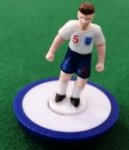
The picture of the players shown above is from the promotional campaign. When I saw these in the newspaper I wondered how much they had been remodelled, as they do look very close to the standard Netcam figures. In fact, look at the Liverpool player at the top of this page, with long brown hair and slim figure - and you realise how unisex the new releases are anyway. I have been asked if I was playing with a woman's team when I have these long haired players on the pitch! (For the record, the women players in the FA Cup set do have their overall shape amended - it is more obvious from certain angles). A nice addition to the range, if Subbuteo/Hasbro/the FA had been brave enough to really release it.
The John Lewis Special Collector's Edition 2015.
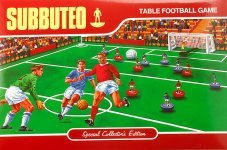
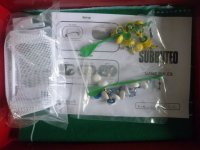
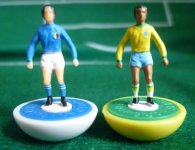
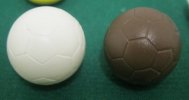
An unexpected UK arrival for Christmas 2015 was this new box set exclusive to John Lewis. Although produced with a new partner store, this is clearly a follow-up to the successful Marks and Spencer set, which was produced as a Christmas set in 2009 (wow, it doesn't seem that long ago does it?). Once again, the set seems to be aimed more at old players than new, and harks back to yesteryear, whilst using modern Subbuteo pieces. The blurb on the back of the box is worth quoting....
"Now regarded as one of the classic games of all time, this special limited edition pays reference to the golden age of Subbuteo. The new "vintage" Subbuteo, with exceptional attention to detail, is the perfect way to enjoy the classic Subbuteo game."
New vintage huh? As with the Marks and Spencer set (see below), the figures and accessories are based on the Italian Fabbri Editori partwork. That means the the bases have Subbuteo 09©Hasbro around them, and the players are hard plastic in the old lightweight style (albeit the new thinner casting of the partwork teams). Whilst the Marks and Spencer set stuck with tradition for its team colours (red/white, and blue white), this version features Italy versus Brazil - hopefully recreating the classic 1970 World Cup final among older fans, rather than the sterile 1994 encounter.....
The interior of the set lacks the display inner of the M&S set, with the contents supplied in bags. This is always a bit disappointing as Subbuteo is fairly fragile, and a little protection for the players is always a good thing.
I must just mention a final amusing "vintage" feature, which is a brown football. This might have to be explained to the young ones!
The Italian Heavyweight Partwork 3 - Platinum Edition 2018-20
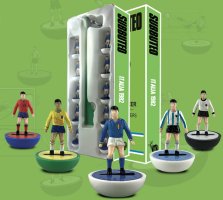
2018 saw the launch of a third La Leggenda parkwork to the Italian market place. This one, called The Platinum Edition, stuck with the heavyweight replicas debuted in The Vintage Edition. Whereas that partwork had concentrated solely on European club football, this one looked at national teams, primarily those who had qualified for the World Cup. Later in the run that rule was tweaked slightly later in the run to allow for Wales and Northern Ireland from the 2016 Euros, and the lovely GB kit from the 2012 Olympics among others.
The pricing was the same as the previous edition, with the first issue at 6.99 euros, the second at 9.99 and the rest at 12.99. As before, many of the issues, especially the early ones, have extras included to make up the game. So there are goals with issues three and six, balls with issue four, and line flags with issues five and seven. Amusingly, the 1966 World Cup England (issue 8) has the referee and lineman set. I wonder if this includes a Russian linesman.... After that, the partwork saw a couple of bench sets, followed by a green fence stretched over about 20 issues. Honestly, like collectors don't already have enough of these things.... and they gave it away on the Vintage edition as well.
Larger accessories - the pitch, a replica brown scoreboard, and a rather natty manual timer, were expensive optional issues.
In my view, the colour work and printing is a step up from the original "Vintage Edition" and once again the range of teams is great. This partwork is not as long as the previous two, and stopped at 80 editions in March 2020. (not sure if the Corona virus helped make that decision).
The Italian (Heavyweight) Subbuteo Partwork - 2014 - 2016
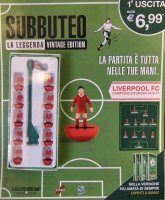
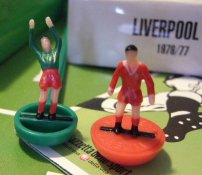
The success of the Italian partwork of 2009-2011 (150 issues), prompted Fabbri to produce a second version. Called the "Vintage Edition". This was a completely new range, featuring players based on the classic 1970s heavyweight figure. Once again, each issue featured a single team from a particular year. Again, the magazines were tiny, and the main purpose of the exercise was to sell replica Subbuteo teams. The first issue featured Liverpool's European Cup winners from 1977, and the second issue had Manchester City's Cup Winners Cup team from 1970. As the lightweight partwork featured no English club sides at all, this might suggest an attempt to get this one sold in the UK. We shall see. The first box also mentioned Nottm Forest, Aston Villa, PSG, Borussia Dortmund, and the Italian trio of Milan, Inter, and Juventus as planned issues.
The figure is a new casting, and first impressions are not that great. There are better reproductions out there, and there has been criticism on Italian forums. The teams seem to be a mix of hand and machine printing, although there is a nice badge on the Liverpool, which I'm assuming is a transfer. The boxes are also based on the 1970s long box, with a modern twist - for one thing the insert is plastic. I suppose this could be falling between two stalls, although they look nice stacked. There is a Liverpool FC hologram on the box, so this team was an official issue.
The advert on the back of the packaging shows old style accessories, with balls and flags being produced with retro logos, plus a green fence and 1970s style bench set. The first team was priced at 6.99 euros; the second issue has a DVD (with rules?) and was 9.99 euros. After that, the price rose to 12.99.
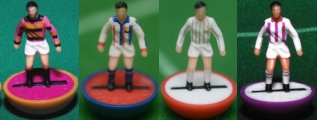
The partwork eventually ran to 137 issues, which was a pretty impressive number (if a slightly weird place to stop...). The partwork was heavily focused on the leagues that did not feature in the lightweight partwork (for licensing reasons I think). All were from the European leagues. A quick count makes it 43 English sides, 25 from Germany, 23 from France, 15 from Spain, and no more than five from any other European country. There was a very slight overlap with the lightweight partwork teams - noticeably with Portugal and Scotland. Oddly for an Italian partwork, the Italian teams did not extend past the promised Juventus and Milan.
As with the earlier selection, the teams were spread across the ages. Somewhat surprisingly given the whole "vintage" vibe, some of the teams were actually very modern - the Chelsea team chosen was 2011, and there were several German teams from the 1990s. Some of the later teams in the partwork got more into the vintage spirit - Victorian FA Cup winners Wanderers (No 90) and Old Carthusians (122) were a surprise. So were old East German teams Dynamo Berlin (114) and Vorworts Berlin (121) the later wearing a natty yellow and red combination.
The Italian (Lightweight) Subbuteo Partwork 2009-2011.
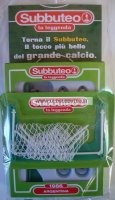
Any visit to a newsagent in the UK will reveal a few magazine partworks. In the old days, these magazines would collect into a big reference book, but now the magazine is secondary to the cover mounts. They all follow a similar pattern. The first part is sold cheaply to generate interest. Then the next half dozen or more are offered to the news trade as "sale or return" and displayed prominently to obtain orders. After that, the partwork disappears from the shelves, but the magazine continues to be sold to those who have placed an order for it. In the UK, we have certainly seen a few "toy collectable" partworks, notably diecast vehicles, trains and model soldiers. The most recent examples have been tanks, tractors, and the James Bond car collection. However, the majority of UK partworks these days seem to be for young children or provide episodes of long running TV series on DVD.
Visiting toy collector fairs though, it is obvious that the collector partworks are much more popular in France and Italy. I'd often thought that Subbuteo would make a good partwork. The magazine could feature a different team every month, with the relevant Subbuteo side as a covermount. So it is no real surprise to see an Italian partwork do just that.
Licensed from Hasbro by Fabbri Editori, this was a weekly partwork with a price of 9.90/9.95 Euros each. It was initially planned to be forty issues, but as with many successful partworks, this was extended whilst interest remained high, and eventually 150 issues were produced.
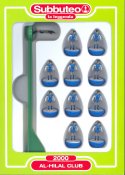
Each issue was based on a team of a particular year. The small eight page magazine explained the significance of this side, and included the line-up and little titbits of information (in Italian of course). Then the team was supplied in Subbuteo for you to play with. Excellent. The teams were in standard lightweight format, with an 1980s style base. However, close examination revealed that this was a new mould. It is rumoured that the Waddingtons moulds are "missing in action", but perhaps they were just in the wrong country. These were hard plastic figures of course, but like Netcam's teams, they were on flesh coloured plastic. They were also very well painted. Some of the teams really are exceptional. The base was also a new mould with Subbuteo 09©Hasbro around the top.
The boxes were a fitting tribute to the lovely 1980s display box, with the familiar new Subbuteo logo, and team details printed on - so each team had a unique box. However, the interiors were plastic rather than polystyrene.
The teams issued in the partwork were an interesting mix. Originally, the teams were national sides, from World Cups, or European Championships. The first twenty-five teams were as follows:-
Brazil 1970, Italy 2006, Argentina 1986, France 1998, West Germany 1974, Holland 1974, Uruguay 1950, Soviet Union 1960, Italy 1982, Cameroon 1982, England 1966, France 1998, Spain 2008, Sweden 1958, Peru 1970, Italy 1934, Portugal 1966, Ireland 1994, Yugoslavia 1968, Columbia 1990, Greece 2004, Hungary 1954, Mexico 1986, Italy 1938, East Germany 1974, and Italy 1968.
In some releases, as well as getting a team, there were accessories such as a goals, balls, benches etc, which enabled a playable set to be built up. There was a coupon with each release and if you collected 30 coupons you could send for a free professional pitch.
After twenty-five national teams, the part-work switched tact, and started on famous Italian club sides, so lots of Milan, Juventus, Roma etc, but also successful smaller sides such as Verona, Udinese and Catonia. This continued for another twenty-five teams (so to ref 50), with some interesting historic sides towards the end, such as Casale (Italian Champions of 1913-14),and 19th century versions of AC Milan and Juventus.
After that there was a short run of South American Club sides (50-61), then a return to World Cup teams (63-80), then an expansion into famous European club sides, before the series turned into a mix of all these different elements by the time it reached the 100s. Later it even dipped its toe into other FIFA regions (138 Al Hilal club, 139 UNAM, 140 Al Ahly).
There are a nice mix of club colours in this collection, and it also fills some gaps in a lightweight Subbuteo collection. Frustrated Subbuteo never made a Sao Paulo in their South American expansions? Well, its here. Annoyed that Subbuteo's world cup issues stopped before South Africa or Ghana could be included? Well, here they are.
I was hoping that a UK partwork company might take this one on (surely it would sell better than most of the tat we do get!). However, I guess the new Netcam license, and the fact that the teams involved are not British scuppers this idea.
You can find the full list of teams on my La
Leggenda Partwork page.
The official website is
http://www.edicolafabbri.it/Opere/Minisiti/60190/opera.html
For British buyers, the reasonably priced
Mad-About-Games seems the best
option.
Marks and Spencer 2009.
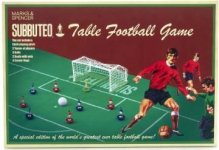
I will admit that this range was a welcome surprise, when it arrived for Christmas 2009. Using items originally produced for the Italian partwork shown above, this was issued in a lovely retro-style box, and retailed at £30. It was backed up by a range of Subbuteo branded items, clearly aimed at adults and collectors, such as a mug and a flask. The sets sold out really quickly, and I am under the impression that Marks and Spencer had seriously underestimated demand. In fact, two years on, this set still sold on ebay at a premium over the original retail price.
See the Marks and Spencer Set page for more details.
The 2005-07 "photo-real" Subbuteo Range by Hasbro.
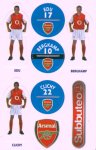
Hasbro's new spin on the old game survived for three seasons. It has to be said that the view within the playing and collecting communities was luke-warm at best, and mostly down-right dismissive, which I'll deal with elsewhere. Published under the MB Games brand, these sets are now fairly plentiful at car boot sales if you want to give it a whirl.
The main innovation was the "photo-real" players. Supplied on cards, the flat players featured the names and faces of modern football stars. These could be collected and swapped like football stickers, the idea being that you can assemble a dream team of top players. Perhaps in keeping with real life, Subbuteo had joined the cult of celebrity, where individual players were more important than the clubs they played for.
The full edition featured in detail on a Focus On... Photo-Real Subbuteo page, or visit Photoreal Subbuteo 2005-07 for more details of the full range.
Other Table Soccer Developments.
The renewed interest in Subbuteo/table soccer in both playing and collecting circles has meant that although Hasbro have the official licence, they are not the only company making Subbuteo compatible equipment. With the new Subbuteo mostly aimed at kids rather than current players or collectors, it allows amble room for other companies to share the market. See Subbuteo clones for more details on some of these alternate table soccer sets.
Zëugo by Edilio Parodi snc
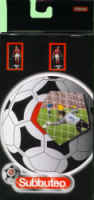
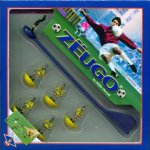
Edilio Parodi snc, are an Italian toy and game company based in Genova (Genoa in Italy). They were responsible for importing Subbuteo into Italy during 1970-90s. Towards the end of the 1990s, Hasbro stopped supplying Parodi, who then continued to cater for the large Italian Table Soccer fan base by producing their own version of the game called Zëugo. This table soccer set used hand painted teams based on the classic heavyweight figure that had proved so popular in Italy in the 1970s. In 2002 Edilio Parodi received a licence to produce new Subbuteo items, once again for the Italian market. This resulted in a new box set, accessory range, and a large number of teams. In December 2003 it was announced that Hasbro were not renewing the Parodi licence for 2004, but the licence was extended first to June, and then December 2004 as the launch date for Hasbro's new game was adjusted.
With the ending of their agreement with Hasbro, Parodi shifted their Chinese workforce back to Zëugo production, and a new range of teams was produced for that game. When it was first announced, this range was to feature some previously unseen teams such as Arsenal 2nd (illustrated with the lovely, but dated two-tone blue kit from 2003), Valencia 2nd (orange with black trim), Vasco de Gama, and Werder Bremen (their odd orange and green strip), along with more familiar fare. However, as the Subbuteo licence survived into 2004, some of these teams were added to the Subbuteo range instead (with a more up-to-date Arsenal 2nd), and others dropped from the plans.
The first wave of new Zeugo arrived in Spring 2005, and featured 44 teams taken from Parodi's old Subbuteo line-up. Furthermore, the team colours were not updated, and were mostly "big" clubs. i.e. team colours that Subbuteo collectors would already have in several other lines. The teams were available on "classic" Zeugo bases, or on the new outers used by the Parodi Subbuteo range.
2006-20 Developments.

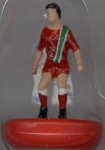
2006 saw the range amended slightly. Firstly, the teams were rehoused in an attractive blue box, which was more compact than the original design, but allowed room for a spare outfield player. Although the above illustration suggests a similar sized box to the Hasbro/Soccer 3D window boxes, these are actually quite a bit larger, and allow the players to be comfortably displayed and protected (as you can see with the Juventus player shown). A couple of new kits were added including the Juventus away kit from their ill-fated 2005-06 campaign. The biggest change however was in the bases. With the Enrico Techiatti designed "Subbuteo" base moving to Soccer 3D production (see below), Zeugo switched to Profibases.
Zeugo players are a chunky version of the 1970s heavyweight, and being big and painted in glossy bold colours, seem well suited for younger players. Having said that, they are a hard plastic, and we have managed to break the odd one at Worthing simply by having them flicked off the table. It's a good job a spare is provided. The Profibases are designed for modern table soccer play. These are a heavy figure/base, and perhaps that makes their touch a little hard on the ball. But they are perfectly useable again more expensive "professional" alternatives.
October 2006: Surprisingly perhaps, the Zeugo box set
featured in the catalogue (and website) of my local toy shop - Gamleys. In addition, the Freemans
Christmas gifts catalogue of that year featured not only the set, but a range of
Premiership kits to go with it. These teams were in the numbered Zeugo range,
mostly between 50 and 75.
April 2009: The team range continues to grow. Astrobase have the range
standing at 122, and it does look as if teams drop from the range as they sell
out. Unlike the old Zeugo team range, newer versions of the same clubs do not
get the same number in the range.

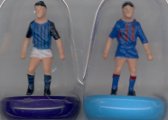
2012: The Zeugo teams are now housed in a minimalist green and white box, perhaps attempting to highlight its popularity with 1970s Subbuteo player/collectors who appreciate the shape of player and the hand-painted look. Pleasingly, the large box size remains, as does the spare player. The new teams illustrated are ref 250 Rochdale and 258 Inverness, which suggests that the Zeugo range is expanding rapidly, as Italian table soccer team collections seem destined to do.
For British buyers, Subbuteoworld always has a large stock of Zeugo, or alternatively (as above) try Mad-about-Games.
2020: This site now has a Zeugo by Edilio Parodi page with lots more details of sets and accessories.

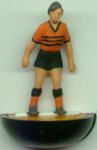
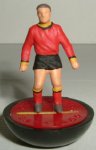
Whilst many of the products on this page are designed for the 21st Century player, Santiago Table Soccer unashamedly looks backwards at the history of Subbuteo, and is none the worst for that.
Santiago football teams are based on the classic heavyweights of the 1960s and 1970s, both in style of player and in base type. There are figures based on both the short-sleeved, v-necked figure of the early 1960s, and the round-necked long-sleeved classic of the 1970s. The figures come in either white or flesh coloured plastic, and can be bought both painted and unpainted. There are diving and crouching goalkeepers, and a fine selection of base colours for every occasion. These figures paint up really well, and kits from the 1950s to the 1970s rarely look better on anything else. I am very partial to the short-sleeved 1960s figure. This figure also seems to suit any modern slim-line outfits, or the short-sleeved NASL kits of the 1970s.
In 2009, the production of the Santiago football teams was taken over by Mark Parker from his Santiago Website. His teams are in a new green box, and the goalkeeper rods come in a selection of different colours. The design of the box is the same as previous boxes though, and is the same size as the classic Subbuteo "long box".
Santiago was originally created by Chris Stapleton, a fellow member of the Worthing Five-Star football club. Beyond the successful football figure, Chris also trialled a few other Santiago products. There were pitches in various colours, a base for pegged figures, which was nearly identical to the 1990s Hasbro base (but with a better range of colours) and also a reproduction rugby base. These again seemed popular, and Santiago rugby teams were a popular feature of ebay for a while.
If there is one problem with Santiago teams, it is that the weight seems slightly top-heavy. It's a puzzle as to whether the base plastic is too light, or the figure is a little chunky. I seem to have less trouble with my short-sleeved teams. However, Mark leaves the bases unglued, so it you want to try altering the weight of the base, it isn't a problem. That said, perhaps we're just used to playing with different figures these days. A little while with these, and you do adjust your technique.

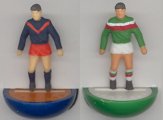
2012:- As well as the paint-your-own options, Mark now has a great range of painted teams in attractive window boxes. You can choose from classic Subbuteo originals, to modern day kits. These teams are beautifully hand-painted in matt colours. Recommended!

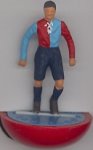
A new venture for Santiago is this "vintage" figure. Unlike the other player types in this range, this new figure is not based on any existing Subbuteo player. With long sleeves, and very long shorts, he is the perfect figure for those interested in the unusual football kits of the Victorian era. The figure is compatible with the existing Santiago slotted base, and the wide range of colours available in these will come in very handy for the often colourful period outfits.
As usual with Santiago, the vintage figure is available unpainted. However, Mark has his own range of these teams entitled "Eminent Victorians", which are so beautifully painted and boxed, that you will wonder whether it is worth the trouble of painting your own.....
Soccer 3-D by Astrobase.
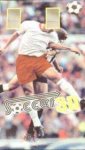
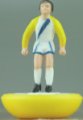
Astrobase are the leading Italian supplier of table soccer items, and are run by Enrico Techiatti. Techiatti's astrobases are regarded as the best quality pro bases, and come in a bewildering choice of sizes. Techiatti also designed Parodi's Subbuteo base and also his Subbuteo accessories such as the goals and fence.
With the ending of the Parodi/Hasbro agreement, Astrobase launched their own range of teams using the base and playing figure designed for Parodi, but obviously without the Subbuteo logos. This range was originally produced in conjunction with Subbuteoworld in the UK, but this agreement seems to have ended, with Subbuteoworld concentrating on heavyweight style Zeugo teams, whilst other UK sellers now have some 3D stock (for example Tornado Toys, Subbuteotablesoccer, and World Table Soccer).
The packing is a lower quality than the black box Subbuteo. The card box is thinner, and without the hanging tag. The white plastic interior is quite thin, and suffers the same problem as many late Subbuteo boxes - the indents are really too small for the assembled figures and their heads stick out. Some of the bases don't have as crisp a fit as the Subbuteo ones, but it is not a major problem. The painting style is glossy, and quite distinctive. It is not to everyone's taste, but I think they do look effective in play, and I'm pleased with the ones I own.
All the teams are illustrated well on the Astrobase website (front and back) allowing customers to pick the teams they like with ease.The team range has grown continually, and the number of different teams available is staggering. A look at the Astrobase website shows the 2005-08 range stretched over twenty-nine pages. With twenty-five sides on most pages, you are talking about 700+ teams. The 2009 range adds a further 170+ teams.... At this rate, there will soon be more Soccer 3D outfits, than were produced in the original fifty years of Subbuteo production. With table soccer a minority interest (even in Italy), it does make sense to sell many teams to the same customers, but the sheer quantities here seem overwhelming. It might be possible to collect a theme within the whole range, such as a particular league, or your team's away kits, or World Cup groups.... I wonder how many of each kit is actually sold, and whether it is more of a "paint by request" service, within chosen parameters.
What this does illustrate is a problem of a modern day Subbuteo. The global game has thousands of teams, and fans tend to demand unique kits. With home, away, and third kits, all updated regularly, it is impossible to keep up. The Soccer 3D range gives good coverage of the Italian leagues, and English Premiership of course. There are World Cup teams featuring most of Europe and Africa (there are more than 50 nations in each of these qualifying sections alone!). There are some smaller English sides, and a reasonable spread of top European sides. There are world cup minnows, non-fifa Islands and regions (Cocos, Kosovo, Alaska, even Isle of Wight). The whole of the European Championship finals in 2006 (home and away) is covered, and many of the teams from the 2003 Subbuteo range (260+ teams in itself) have transferred across. There are a few South American and Mexican sides as well. The decision to sell named teams rather than numbered does leave far too many similar teams in the range. There are countless red/white/red kits that could have been covered with one team. Some teams also sneak back in as a later dated kit, or as a different side (the old Subbuteo Fulham is Salamanca in the 2009 range). Nevertheless, the range is still an immense undertaking, and something to be marvelled at!
There is also a Soccer 3D "heavyweight" range, which seems to use the original Zeugo figure and base. This has yet another selection of teams, that includes most of the original (and now hard to find) Zeugo colours, in addition to an mix of old British sides, and some strange bits and pieces. It does look like an attempt to cover the teams produced by every other table soccer manufacturer on h/w style figures (i.e. Zeugo, Santiago, World Table Soccer). It gives this second range a rather cynical feel.
Soccer 3-D also have a range of accessories which nearly match the teams for sheer choice of finish. You can have fences, referees and balls in just about any colour you fancy. In addition, the new Soccer 3D version of the Astropitch has been very well received by the table soccer community.
There don't seem to be many outlets for Soccer 3D in the UK, but Astrobase are happy to send orders overseas.
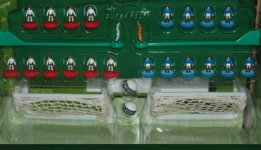
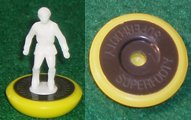
Superfooty was originally launched by an old friend of this site, World Table Soccer. This was another well presented set, backed up with a range of teams. Originally, the game had a figure similar to the old heavyweight, but with the modern round base fitting. The figure was quite chunky, which mde it fairly easy to paint, and robust for younger players.
The modern version of Superfooty has its own named website. There doesn't seem to be a full box set at present, and the figure used is now a Stefan Corda style 2K4. The site also sells a reasonably priced "pro" base, the GT Turbo, which I believe is based on (or in fact is) the old reliable Sureshot base.
The Stefan Corda Company.
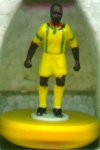
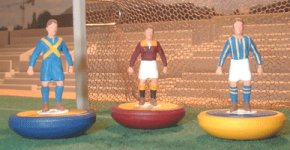
Another small innovative UK company, Stefan Corda seem to have had a very short time as a retailer, but their CAD figures really changed the look of table soccer in the 21st century and are still seen in other ranges such as Astrobase's Soccer 3D, and Superfooty.
As their products are no longer available directly, I've moved the details to the Football Clones that is designed more as a historical record.
Total Soccer (2009-2011).
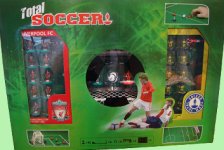
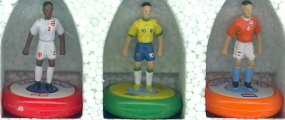
Total Soccer arrived in 2009, and was made in China by a Spanish company, Netcam. It was initially designed for the Spanish market, but later expanded to other key table soccer playing nations - Italy, Greece, and England.
The game ceased to be produced when Netcam obtained an official Subbuteo licence. Like the Stefan Corda range, these details have moved to the Football Clones page.
[ Main Page ]