[ Subbuteo
Menu ][ Teams ][ Accessories
][ Index ][ Links ][ Mail
Me ]
| Peter Upton's |
Subbuteo Tribute
Website.
|
Figure Type
Identification. |
Subbuteo is mostly a jargon free zone, but most of the technical
terms we have seem to revolve around player types. Certainly terms like heavyweight and
zombie are likely to confuse players and collectors who haven't heard the terms
before - even if they recognise the players. For those who played in an era
where only one player type existed (like the 1980s) this is a chance to catch up
on the other forms that Subbuteo has taken.
The Flats.
 --
-- --
-- --
--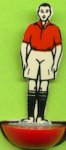
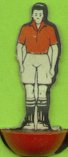
Illustrated from left to right: Cut-out card figure, Press-out card figure,
and two celluloid players.
The flat teams were the first teams to be produced, and were the
form Subbuteo took throughout the 1950s. The players are taller than the later
OO scale teams, and the bases are smaller. This results in a playing piece that
has lovely balance and touch. The figures continued to be sold into the OO scale
era until the early 1970s, and were the preferred playing pieces of the serious
tournament players up to the mid 1980s.
- Cut out yourself cardboard figures. The
earliest figures,
produced for the first sets of 1947. By the 1949-50 assembly version, you were already provided with two
press-out teams, so these can't have been made for very long. However, a
couple of site helpers who played in the 1940s and 1950s players remember using them, so they can't have been
that unusual.
- Press out card figures -
As mentioned above, these teams replaced the cut out ones by the end
of the 1940s. The main advantage over the cut out teams was that you were
less likely to bend the players when separating them from the surrounding
card. They are also made of a thicker card. The only disadvantage is that the figures have a big black outline,
that affects the look of the player.
A full team of card players including bases was Set D in the old range,
and you could buy two press out team sheets without bases as Set G. Both
these sets were available right up to the 1971/72 catalogue, and were
available in numbers up to 50 or 55.
- Flat celluloid figures -
These figures too were established in the 1949/50 catalogue.
Interestingly, the full set with bases (Set D) remained a card set, and
the celluloid figures seem to have only been sold without bases (as Set
O). For this reason, teams were always sold in a flat packet, and not in
team boxes (although Set S was produced to store assembled teams). I've scanned two celluloid figures, because they look a
little different. The figure third in the line-up above is the earlier
version, and has rather square shoulders, and faint markings. The final
figure has bold markings which look almost embossed, and the red is
printed on.
Note that these early figures don't have different sock
colours. Although replaced by OO scale figures around 1961-62, Subbuteo were still trying to sell
these sets up until 1971-72, and the flat box sets were still being advertised as late
as 1976.
OO Scale players from team
boxes.
 -
- -
- -
- -
-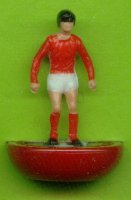
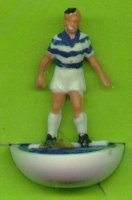
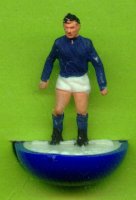
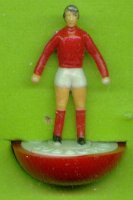
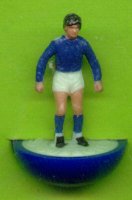
Illustrated from left to right:- Early Heavyweight, Classic Heavyweight, Zombie, Lightweight, Hasbro.
The OO scale figures appear around
1961, and really caused Subbuteo to take off as a game/toy aimed at youngsters.
The new figures were on a larger base, which was produced in two pieces - an
inner and an outer. The bases can be in a variety of colours - with the same
team often appearing on several different base colours. A good example would be
Brazil, who can be seen on a variety of green, yellow, blue and white inners and
outers.
- Early (or short sleeved)
heavyweight (h/w). These figures were the first OO scale figures to be produced,
and are poorly detailed with a strange posture, and a rather flat appearance.
They fit to the base with a bar and slot fitting (copying the flats). Only available from 1961 to
sometime around 1967-68, they had been superceded by the
mid 1960s, and I don't think they go any higher than 55 in the number chart
(although the named 1966 World Cup teams were also produced in this figure).
- The classic heavyweight figure
(h/w) -
Designed by Charles Stadden, this improved heavyweight figure arrives
around 1967, and is the standard Subbuteo footballer until the end of the
1970s. Like the short sleeved heavyweight, this figure is attached to the
base by a thin bar. Both h/w versions were hand painted by Subbuteo outworkers
in the Tunbridge Wells area. The figure was phased out in 1980 and 1981,
and the old stock used up at that time. This means that teams up to 322
were in the heavyweight era, but teams to 359, plus 501-509 can
also turn up in this figure (especially in Italy).
- Zombies - A derogatory
term for these unloved figures - so called because
they are so lifeless and lacking in detail. The figures are fitted to the base on
a peg, and can be machine, or hand painted. They were produced approx
1977-80, which was the end of the h/w era, and they never quite managed to
replace that figure. Theoretically, they could be available in all the
colours of that era - i.e. all numbers up to 322, and possibly up to 359.
However, the short life of the zombie suggests that not all the teams
would have been painted in this figure. Certainly long disused teams like
Darlington at 69 and West Ham 2nd at 79 were still in the range in the
late 1970s, but I can't see any demand for them beyond any unsold h/ws
that Subbuteo Sports Games might still hold. Nevertheless, experienced
collector Paul Lloyd assures me that all references in the 1981
catalogue (up to 359) were produced as zombies.
- Lightweights (l/w)- Test
marketed in various regions of the UK in 1980, the lightweight was
introduced to the public at large in the 1981 catalogue. Once again, they
are on a peg, but this time the figure is much more detailed - with bent
knees like a heavyweight, but in a much finer, lighter design. These
figures are usually machine painted, but hand-painted ones appeared for
the first year or two of production. The figure is the only one
produced from 1981 to 1996, and the player itself is still used on Hasbro
teams - only the base changes.
Again, Paul Lloyd states that all the reference numbers to 350 were done
in this figure.
- Hasbro Figures - It's debatable whether this can really be classed
as a separate figure. The actual player is unchanged from the lightweight,
but the base is a new one-piece design. The base arrives separate to the
player, and has to be attached by the owner. The figures produced by Hasbro from 1996 to 1999
have a much flatter base, so the performance of the team is altered (which is
why this gets classed as a different figure). The renumbered Hasbro range are only
available in these bases, but there are also about 140 of the older team range
still available in 1996, and these sides were also produced on the Hasbro
base. The ten new 2000/2001 Hasbro teams are still on one colour bases, but the shape
is of a more traditional design (and sadly not as well finished - leading to
some wonky players). The only exception seems to be teams with black bases
- who still seem to be on the older base (Newcastle Utd and the Man Utd
2nd from the Man Utd box set)
OO scale experimental/box
set figures 1960s-mid 1970s
 -
- -
- -
- -
-
Illustrated from left to right: walker, rugby, winged shorts, moulded H/W,
and Scarecrow.
There were a
number of other football figures produced by Subbuteo in the 1960s, and early
1970s. With the exception of the figure also used for rugby sides, these
figures are recognisable by the fact that their feet are moulded to the base. Illustrated
above are five variations of box set figures.
- Walker figure - These seem common in box sets of the
1960s and very early 1970s. He is a rather thin figure, and this makes him look
tall (although I don't think he is). He has one foot set in front of the
other - but the post looks distinctly unhurried - hence a
"Walker".
- Rugby figure - This is the figure used in the early
rugby teams - say 1968 to mid 1970s. However, this version came from a
1967/68 football Club Edition. Actually, there were only four or five of
these figures in the edition - the other players being mainly Walkers.
Certainly, the use of these players in football sets doesn't seem
widespread. But it is worth noting that the player is designed to have short
sleeves, as he has here, although he is always painted with long sleeves as
a rugby player. This is the only "box set" figure to be fitted to
the base with a bar and slot .
- Winged Shorts figure - An odd player who
seems to appear in early 1970s box sets. He seems okay in play, but if you
study him, he actually looks a bit deformed, with a long, wide body, and
short legs. In fact, he has almost no feet at all, and very short socks - as
if he has sunk into the base. As you can see, the shorts on this player
stick out in little points - a bit like those trousers airmen used to wear!
Oddly, this figure very occasionally turns up as a slot and bar figure. In
this guise he actually has feet! The figure is on the
Team odds and ends page if you wish to compare.
- Moulded Heavyweight figure - Nobody seems to have thought up
a name for this one. The figure on this one is identical to Charles
Stadden's classic h/w design, although again the feet are moulded into the
base. Like the winged shorts players, this team is seen in 1970s boxed editions, but also in Football
Express.
- Scarecrow or bandy legged figure - This guy has a
really 1970s feel with long hair (shaped around his head like a sphinx!).
His widely spaced legs, and long dangling arms have resulted in a couple of
insulting names - and he does look as if he should be carrying a bucket of
water in each hand. Again, these figures are seen in 1970s editions (although not
as common as any of the above) and like the moulded h/w, he's been seen in Football Express.
The most common place to see
them is in the box sets
of the 1960s and early 1970s. This means that they are usually only seen in the
standard red/white or blue/white strip. However, the "walker" figure
has been spotted in all white (like 21), and white with dark blue shorts
(England - like 154). I've also seen the winged shorts player in that
England kit. These alternatives may well come from the "International
Edition" box set, where three teams were provided. I've also heard that
they were sometimes used for the extra teams in World Cup sets (i.e. Holland, or
Brazil).
Whether any of the five "experimental" figures were ever sold in a team
box has been much debated in collecting circles. Original collector club founder
Paul Lloyd has heard that the Subbuteo factory once sent these figures to
outworkers instead of sending heavyweights resulting in them being painted in
team colours 1-76 in small quantities.
Where moulded teams
do turn up in alternate colours are in the five-a-side Football Express team
sets. These were generally sold in the following colours - ref 1, ref 2, ref 5
(Man City), ref 7 (West Ham), ref 10 (Fulham), ref 16 (Arsenal), ref 21 (Leeds),
ref 25 (Celtic), ref 41 (Liverpool), and ref 42 (Chelsea).
The Italian Hybrid.
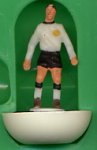
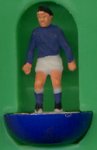
This is the figure that catches a lot of English Subbuteo fans
out. It was produced in (Portugal) by Edilio Parodi's Italian company as a response to the
unpopular zombie. It is basically Charles Stadden's classic heavyweight re-cast
onto a peg - so as to fit the new style bases being used on the zombie.
Actually, it looks as if they had a little trouble with his casting, as there
are two versions of this figure, one much thinner than the other. The key
difference is in the heads, with one being a pinhead, and the other
having a fat head. Both look a little comical, but perhaps that is just because
I am used to the standard heavyweight. Many thanks to Marco Longinotti, who
produced the fantastic photos of these two figures. In addition the Portuguese
produced these figures for their own range of teams, and also cast a poor copy
of the lightweight for their teams.
The
Italian Production page goes into a bit more detail
about hybrids.
The International Team Production shows the
Portuguese production to good effect.
The 2003-04 Edilio Parodi Figures.
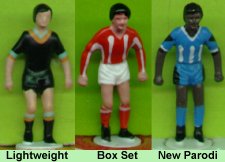
When Parodi gained a licence to produce new Subbuteo items in
2002, they designed both a new figure, and a new base. As usual with Subbuteo
there are variations. The early box set figure has thinner ankles, and short
sleeves as part of the moulding. The more standard team set figure can be seen
on the right on the above scan. The figure also has a couple of alternative
castings - a bald player, and a player with a pony-tail.
Rugby Figures.

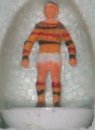
Like everything else, the rugby teams have rarer variations.
The vast majority of rugby teams produced are in two main figures. The chunky
rugby figure shown on the left here, and the heavyweight footballer on a rugby
base, shown on the right. However, rugby editions from about 1978 onwards are just filled with
footballers on standard football bases - first heavyweight, then zombies, and
finally lightweights. These are usually in the standard red or blue, but
apparently all these figures were used in rugby team sets.
- Rugby Figure - Used in all the early box sets that
I've seen, and in the early range of teams - i.e. up to team 26. I've never
seen one in the later range that goes up to 37, but then I've not seen very many of
those teams at all, and I've been advised that they were indeed used in this
later range. The teams are supplied on a special rugby base. This
is a one piece, one colour base, slightly deeper than the standard football
one. The base seems to be solid plastic, but has a groove each side of the
player that can be used for holding the ball during a line out. The player
is on a bar connection, and can very occasionally be spotted as a
footballer (see above)
- Heavyweight Figure - The standard h/w footballer, but
set into the rugby base. These seem to replace the rugby ones (perhaps the supplies had all been painted up). The figure can be seen in later rugby
editions, in all boxed team colours up to 37 (which is as high as they go...),
and also in the Italian rugby team range.
The rugby bases were not produced after 1975, so once all the stock had
gone, the teams were sold on standard football bases.
- Zombie Figure - See the football range for this
figure. It is usually only seen in rugby sets, but has been very occasionally
sighted by older collectors. Could be in any number up to 37.
- Lightweight Figure - A couple of teams in this figure
have recently come to light in collecting circles, and again the figure
could appear in later rugby sets up to ref 37.
That concludes my little page of figure identification.
Text and Site Design
- Copyright (c) 1999/2020 Peter Upton.
[ Main Page | Previous Page ]