
| Peter Upton's |
Subbuteo Tribute Website. |
|
The Team Colours Project. |
|
Classic Heavyweight 1967-1980. |
|
References 301-322 + named catalogued sides. |
The 1978 expansion of teams continued all the way up to reference 321, including all the C500 home international teams at the end of the run. The 1979 catalogue saw just one additional team, reference 322 Iran, which was added for the 1978 World Cup.
Six more teams were added for 1980, but the more crucial thing is the arrival of the lightweight figure, a new (and much improved over the zombie) machine printable figure, which signalled the end for the heavyweight. The lightweight does appear on the cover of the 1979 catalogue, and some appear prior to 1980, but this is the first year where they really start to take over. The vast majority of teams produced for refs 323-328 do seem to be hand painted lightweights. In fact, only a couple of h/ws have been sighted for these numbers, and they could be explained by the earlier non-catalogued named box teams.
The 1981 range continued this theme, and saw the first classic lightweight machine prints, of which the complicated 329 England was a stunning example. This kit would simply be impractical to hand-paint for mass production. However, as the Italian catalogues of the early 1980s do still show some of these kits in heavyweight form, these have been added to this page for the sake of completeness. However, the big h/w collecting sites seem to include few, if any convincing examples. It could be that Parodi painted the teams for their catalogue pictures using their existing stock (as many hybrids are included) before the real teams arrived. If anyone has a true heavyweight in these colours, please let me know.
The page concludes by summarising all the non-numbered heavyweights that featured in catalogues in the UK and abroad. These teams do have their own pages within my website, but are repeated here to add completeness to the list. The non-catalogued named box teams have now expanded into their own page - Named box teams - which now concludes the run of heavyweight pages.
Team Colours.
Dating information - the date in brackets is the final year that a team appeared as a lightweight figure.

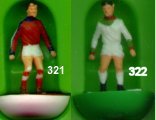
The 1980 and 1981 Ranges - Teams 323-359.
As I have mentioned before, the Italian catalogues of the 1980s-90s are illustrated with actual figures, and some of the teams in the 323-359 range are clearly illustrated with standard heavyweight figures. This suggests that some of these teams were sold in Italy in this figure. In addition, long-term Subbuteo collector (and sometime SSG employee) Paul Lloyd has told me that all the 1981 teams were painted in all three figure types (h/w, l/w and zombie). However, evidence on the ground suggests otherwise and I am becoming doubtful that these were officially released.
I added these teams to this page many years ago, and despite a huge increase in interest in collecting, and the online display of some big h/w collections, ALL these teams remain elusive. The English teams released in 1980 (refs 324-328) are reasonably common as lightweights, but don't turn up as h/ws at all. The h/w pictures in this next range come from the Italian catalogues of the early 1980s, where real figures were still used to illustrate the range. However, the figures are painted to match the zombie catalogue of 1981 (i.e. very dark reds) and not to the actual lightweights sold. The illustrations are a mix of lightweights, h/ws and the exclusive Italian hybrids. I would argue that these were painted in Italy for the catalogue, possibly before the real teams had arrived. I assume that if these teams were actually sold in Italy in any number, then more Italian collectors would own them by now.
There are one or two of these teams in collecting circles, and on the various h/w websites. However, none look that convincing to my eye.

Even in the Italian catalogues, all the 1980 released teams (323-328) are illustrated with lightweights.

Perhaps it was just painted for the catalogue, but how lovely is the h/w 337?


The 501-509 Range.
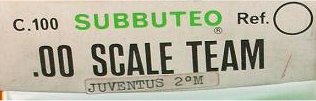
Whilst looking at the 1981 range, this extra group of teams needs to be mentioned. These were originally produced in Italy, and so could fall into the heavyweight era. However, early versions are usually in the Italian hybrid figure rather than true heavyweights, and you can see these on the Italian Production page. These teams are another batch of sides that can appear in named boxes (see above). Does anyone own a heavyweight version of one of these sides?
Subbuteo Sports Games Limited remained remarkably loyal to the number range started by Peter Adolph in the late 1940s. The same numbers can be traced right through Waddingtons production until 1996. Nevertheless, teams were issued outside of this range for a number of reasons. Sometimes it was because the time on release was considered to be short (like teams promoting a World Cup), and sometimes it was because the team's appeal was limited geographically.
Paul Lloyd, heavyweight collector, one-time Subbuteo employee, and founder member of the original Subbuteo collectors club in the early 1990s, has stated that an attempt was made by the collectors club to list all the teams that Subbuteo had released. Sadly, the task proved impossible, as records were missing, and the list just kept getting longer and longer.
This page originally gave a decent selection of the named teams produced. However, attempting to improve this in my 2020 updates, I found that, like the collectors of old, the list just kept getting longer and longer.... In addition, the nature of collecting in the 21st Century, and value of rare teams has meant that there may well be fakes among the un-catalogued stock. So what to do?
Well, once it became clear this page was getting too long, I made a decision to split it up. All the un-catalogued teams now have their own page called Named box teams which hopefully shows the breadth of this area of collecting, if not the full depths. That left this page a little short, so I've used it to summarize all the teams that do appear in catalogues both in the UK and abroad in the heavyweight era. Most of these sections have links to appropriate pages within the site that give more details if required.
The World Cup Ranges 1966 and 1970.
Details and pictures of these teams feature in the World Cup 1966 appendix
1966 World Cup.
The logical reason behind this first set of named teams must have been that Subbuteo would only be selling them for a short time (until the next World Cup), so did not want to to put them in the regular list. Sixteen sides qualified for the 1966 World Cup but the Subbuteo range had 17, as North Korea received two alternatives; either red like ref.1 or dark blue like ref 44. The teams were originally produced in the old short sleeved figure, but later versions appeared in the classic heavyweight which arrived circa 1967-68. See the World Cup appendix for full details of these teams.
However, which teams were produced as classic h/ws is not yet clear, as Subbuteo had simplified the list by 1968. The original list gave individual named kits for all 16 teams, but by 1968 the list told customers to order teams from the standard range for 9 out of the 16 countries. Obviously, there were more anomalies in the original list. A good example would be France who have red socks originally (similar to reference 149, but no shirt trim) but the 1968 list advised punters to purchase reference 2. So the main question is: Was the original list also produced in the long sleeved figure? Evidence is awaited.
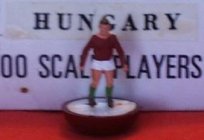
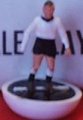
This leaves the 1968 list, and there are two teams worthy of mention here, which have been sighted. The key team is Hungary, described as wine red shirts, white shorts and green socks. Although a Hungary side does finally reach the numerical list as 281 in 1978, this may not have the rich wine red jersey of this original version. The other variation is a West Germany which has reversed socks when compared with the later ref. 156.
1970 World Cup.
All of this sixteen team range eventually made it to the numerical range, and once again full details can be found at the World Cup appendix.
The Italian un-numbered range 1970-71.
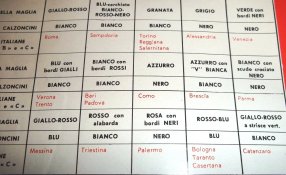
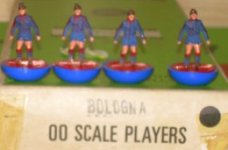

Italian heavyweight collector Alberto Orazi has explained to me that when Edilio Parodi first imported Subbuteo to Italy in 1970 he was unsure of the success of individually boxed teams. So he had Subbuteo paint up the colours of a selection of Italian teams to test the market. These were done as "request" teams, painted in Kent, with the name of the team stamped on the boxes. Parodi produced a one sheet (not illustrated) catalogue of the teams as shown above. The success of the teams led to them being added to the full Subbuteo number range in 1972, as teams 90-99 and 103-106.
Hopefully the picture above is readable enough to get a feel for the range. There are oddities here, such as the "blu" shorts on Bologna. This team had been sighted in collecting circles, but I was unaware that it was in a catalogued range.
April 2022:- Italian collector Alessandro Calvo has
provided a named box version of Cagliari. This team was introduced into the UK
range in 1970, which coincided with Cagliari winning the Scudetto (Serie A) for
the first, and only time. This must be one of the original named teams supplied to Parodi. The team is in a late 1960s logo box, but it does have a plastic handle
keeper.
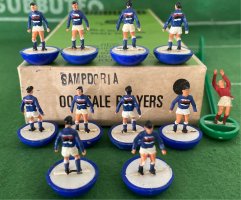
September 2022:- Alessandro has supplied a further photograph of a
stamped box Sampdoria. This box has the later logo (as does the Bologna).
The "hoops" on this Sampdoria are individually painted, rather than having a
white rectangle with the red and black painted onto it (although I've seen
genuine players with both).
The Italian 501-526 Range - "nuove squadre 1976"
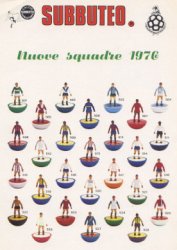
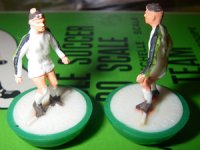
This extra catalogue produced for the Italian market was a new range of club sides. They were produced in both the long and short boxes of the mid-1970s with the usual number circles. Most of these teams ended up back in the standard range anyway, once SSG expanded this for the 1978 catalogue. Full details of their original appearance are on the Italian Production page.
However, there are three teams worth a quick recap here.
522 San Diego Toros - As this looks identical to the already produced reference 77, the Toros were moved to that number in the 1978 catalogue. Actually, the name of this NASL side is wrong anyway. The Toros had ceased in 1968, and the team in 1976 was the San Diego Jaws. There real kit was closer to 211 than 77 if I'm being picky....
512 Borussia M'Gladbach (Germany). This is technically a unique kit, and is illustrated above. Whilst Borussia M'gladbach were placed in the new German range in the English catalogue of 1978, they had amended their kit. The original 512 had black and green trim to the arms, but no collar.
529 Torino. Scudetto winners in 1976, this team was added to the list on the back of the leaflet, but is not on the front.
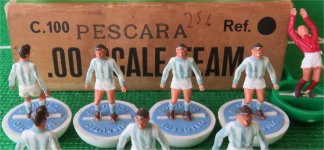
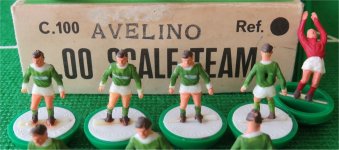
Italian collector Alessandro Calvo has supplied pictures of a couple of these teams with stamped named boxes. Alessandro has only seen the Italian teams with this style of box, which might suggest that the five Italian teams 501-505 were issued prior to the full range.
The Italian C100s Range. 1978-1980 (1986?)

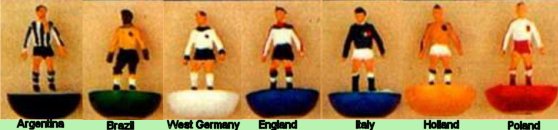
These were sold in individually coloured, and named boxes, and the idea was that the teams would be more detailed and a better quality of paintwork. I have read that Parodi were disappointed with the painted results that SSG sent them however! Some of the teams are no more than a small badge away from the team in the normal range (and Roma usually lacks even that), but some are more unique. They were illustrated in the Italian catalogues in a mixture of heavyweights, lightweights, and the Parodi's own unique hybrid figure. However, all the teams have been seen in heavyweight within the Subbuteo community.
The pictures above come from the 1981 Italian catalogue, which is the last before the machine printed lightweights creep in. The coloured boxes feature back as far as the 1976 catalogue, so the teams get a long production run, but this is the earliest catalogue I have seen the players illustrated. Although the lightweights have not arrived, a few hybrids do look like they have made their way in - It's not easy to tell without seeing the tops of the bases, but certainly Torino and Milan (and maybe Argentina) look suspect. However, these teams have been seen in heavyweight too.
Note that Sampdoria and Verona do not appear to be in the heavyweight selection.
Fiorentia is a unique kit in this range.
Lazio has trim not usually present on reference 5, and Napoli is the Subbuteo "mid-blue" used rarely in the 191-322 range
Torino again has colour issues. Red here in the catalogue, it has been seen in claret (still complete with badge).
Argentina, Holland and Poland all have unique outfits in this range. Their later lightweight machine prints seem based on these designs.
The C100s teams continued into the lightweight era, and later versions are simply the more complicated machine-prints of the mid 1980s. The Italian Production page has the C100s teams detailed.
The French Delacoste Catalogues.
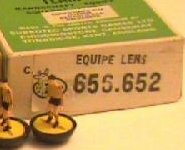
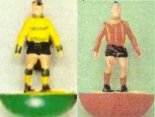
The French seem to like to do things their own way, and distributor Delacoste certainly did that. They had their own distinct box labels and numbering system (which is both more complicated, and worse than the original Subbuteo Sports Games version). The above box is a good example of Delacoste markings.
The French seem to be the only international distributor to really try to keep their own club sides accurate through the heavyweight period and beyond. This included painting their own variations. Although the versions shown in their catalogues look horribly glossy, in real life they are often fairly normal. Again, unusually for Subbuteo, most of the Delacoste variations filter back into the English catalogues, so that a team like 139 Lyon ends up with about four different UK catalogued versions.
Perhaps the only catalogued French teams not shown under a UK reference number are the variant 656.562 Nantes, and the original Lens on 656.652. The Nantes is simply a version of reference 142 with black shorts, but the Lens is more interesting. Usually regarded as simply a reference 23 with reverse socks, closer inspection reveals something different. The red and yellow reference 23 (which later briefly became reference 61), has the red stripes painted onto a yellow shirt. All the 656.652 Lens teams that I've seen online have the yellow stripes painted onto a red shirt.
The Delacoste Teams page gives the required catalogue details. The Team odds and ends page features a couple of strange un-catalogued h/w teams, and has a good argument for them being a pair of French away kits.
Germany
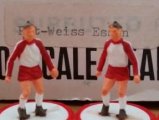
No unique teams have surfaced for the German league, but it is worth pointing out that their 1978 range (teams 210-223) often have typed name stickers on their boxes, rather than reference numbers.
Holland
The Dutch teams arrived in the UK catalogues en-masse in 1972-73. The unique kits for that year's top flight became references 82-89, and the rest of the teams fitted into the standard range, along with a number of the bigger lower league sides. As mentioned on the International Team Production page, the sadly un-illustrated Dutch catalogues feature some very strange written descriptions of their team colours. This may be an updating of teams as the French had done, but no variant teams have surfaced in the community, so we still patiently await details.
Portugal.
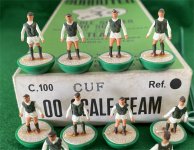
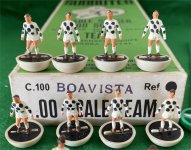
I have been advised that the Portuguese heavyweights were only sold in named boxes in their own country. The important thing to remember is that this applies to all their teams, not just their unique team colours which were introduced to the main/UK catalogue as refs 272-280 in 1977. We've seen a reference six in a named Beira Mar box, and others must exist. As the smaller teams in the 272-280 range were all together in the Portuguese top flight for only one season: 1972-73. This gives us a potential named team range like this -
1 SL Benfica (ref 138)
2 CF Belenenses (ref 2)
3 VFC Setúbal (ref 36)
4 FC Porto (ref 278)
5 Sporting CP (ref 277)
6 VSC Guimarães (ref 21)
7 Boavista FC (ref 273)
8 GD CUF (ref 274)
9 Leixões SC (ref 4)
10 FC Barreirense (ref 4)
11 SC Farense (ref 178)
12 SC Beira Mar (ref 6)
13 CD Montijo (ref 174)
14 CF União Coimbra (relegated) (ref 279)
15 Atlético CP (relegated) (ref 275)
16 União de Tomar (relegated) (ref 276)
The reference numbers quoted here come from the relevant Subbuteo catalogues of the period.
Spare Goalkeepers.
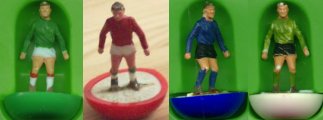
If you have an odd solitary player that you've been unable to identify and you've reached this point, then it is possible that he is a spare goalkeeper. There are probably lots of different spare goalkeeper kits, but the ones in the above picture show some common themes.
The green 'keeper with red sock tops is illustrated in the 1969 catalogue. Sometimes both goalkeepers are the same, and sometimes his partner is in reverse colours i.e. red jersey and green sock tops.
As an alternative, the yellow goalkeeper (with blue sock tops), and the blue goalkeeper (with yellow sock tops) exist, but are less common.
Later 1970s spare goalkeepers tend to have black shorts, with shirts and socks in one of the standard colours (thus matching the diving goalkeepers of the time). The ones illustrated are blue and green, but in my youth I had a red shirted one (I sat on him - oops), and I expect yellow also exists.
Adding to the confusion, collector Chris Allen had a number of sealed spare goalkeeper sets where random players from the team range were sold as spare keepers.
This page once included all the uncatalogued teams issued by Subbuteo Sports Games, or its international distributors. However, this production out grew the page. Therefore please visit the new un-catalogued teams page if you wish to finish the list of heavyweights produced.
[ Main Page | Previous Page | Next Page ]