| Peter Upton's |
Subbuteo Tribute Website. |
|
The Team Colours Project. |
|
Appendix : Made in Italy |
|
Edilio Parodi's Production |
Whilst inventor Peter Adolph will always be the father of Subbuteo, the Italians have a different hero. He is a man named Edilio Parodi. From the mid 1970s, his toy company in Genoa, imported or produced the Subbuteo that introduced so many Italians into the hobby. Although Parodi imported most of his Subbuteo items from the UK, his workers did produce and paint their own teams. Luckily, he also produced his own catalogues, which makes life a little easier for us would-be historians!
This page is an ongoing project looking at the extra production from Italy, and the major anomalies that seem to occur. Forget all the rules, and enjoy the wonderful world of Edilio Parodi.
The Italian un-numbered range 1970-71.
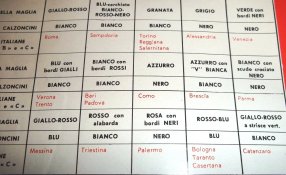
Italian heavyweight collector Alberto Orazi has explained to me that when Edilio Parodi first imported Subbuteo to Italy in 1970 he was unsure of the success of individually boxed teams. So he had Subbuteo paint up the colours of a selection of Italian teams to test the market. These were done as "request" teams, painted in Kent, with the name of the team stamped on the boxes. Parodi produced a one sheet (not illustrated) catalogue of the teams as shown above. The success of the teams led to them being added to the full Subbuteo number range in 1972, as teams 90-99 and 103-106.
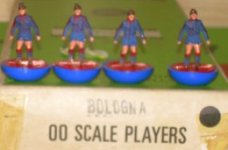
Hopefully the picture above is readable enough to get a feel for the range. There are oddities here, such as the "blu" shorts on Bologna. This team had been sighted in collecting circles, but I was unaware that it was in a catalogued range.
The 1976 catalogues.
A big thank you to Andy Mason, and Blackjack who kindly sent me photos of these catalogues. Many are now available as pdfs on the Subbuteo Club website.
a) Teams 191-195.
Whilst the 1975 Italian catalogue was composed of pictures familiar to the British Subbuteo buyer, the 1976-77 version started to see differences. At its heart, it was still the same fold out poster, but the main picture of a Subbuteo set-up was new, showing off the new grandstands, but also including a pile of the new C100s team boxes (see below). In addition, the team reference section was increased by five teams, with reference numbers up to 195.
These numbers remain a mystery. I have also included them in the standard number range, as they were British sides, and there is good evidence that they were sold in the UK under these numbers. However, this Italian catalogue was their only appearance in official literature. With the exception of the Scotland side, all these teams are more common as named box sides in the UK, than using these original numbers. When the large UK expansion of teams took place in the 1978 catalogue, all these teams were included, but with different reference numbers. The table below shows the relevant numbers.
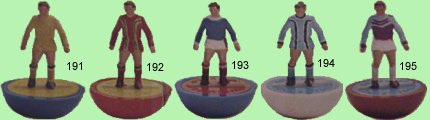
The C500 range was a coloured box range in Britain, that included the colours of the four home nations, plus England 2nd.
b) Teams 501-529.
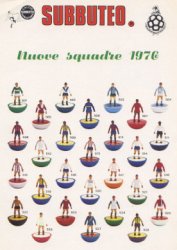
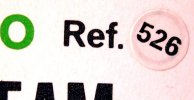
Possibly more intriguing than 191-195, are these teams which were advertised on a flyer inserted in some of the 1976 catalogues headed up "nuove squadre 1976". A few mint versions of these teams have recently been sighted. These teams were available in both the big mid-1970s box, and the later smaller version, with the proper number stickers on them thus:
Nearly all these team subsequently appeared in the huge 1978 team expansion where team numbers in the English catalogues leapt from 190 to 321 (I'm reserving judgement on a couple of sides). This seems to suggest that the 1978 expansion was at least partly lead by Edilio Parodi.
There are five Italian minnows introduced in this range. Avellino, Brindisi and Pescara were in Serie B in 1975-76, Rimini were winning Serie C/B, and Lecco third in Serie C/A. Pescara went on to feature in Serie A in 1977-78 (finishing bottom).



Its worth noting that the Italian, Argentinean, and NASL teams are all in alphabetical order. These teams moved en-masse to the full English range in the 1978 expansion, where they were all renumbered in the 200s. As you can see from the details above, this re-number doesn't seem to have had a great amount of logic involved, and of course being Subbuteo, a couple of anomalies are thrown up. Chief among them is the Washington and Hartford mix-up. In the Italian list, Hartford wore the Tottenham-like kit with the hoop socks, and Washington wore the blue kit with the red and white diagonals. NASL records suggest that this was indeed the correct Washington kit. Somehow, in the English catalogues (and subsequent Italian issues) these teams have been reversed. Whoops. Mind you, Hartford don't seem to have worn blue and white anyway - they wore white with red trim (or the reverse).
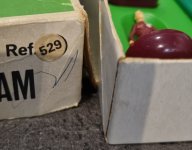
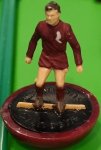
When I was cross-checking the reference numbers of these teams to the British range, I did notice that Torino were the only Italian team in the British catalogue not illustrated here. Italian collector Massimiliano has pointed out that Torino did feature in the list on the back of the 1976 flyer, but they are not on the front illustration. He also sent me these pictures of a Torino with the correct numbered box (I've seen the team before, but not the number). The flyer description doesn't actually match the team colours, however this isn't the only team where that happens.
I am assuming that this alternate Torino was a late addition to the range. Torino won Serie A in 1975-76 (for the first time since the Superga air crash of 1949), and I assume this led to Parodi requesting this new version (Torino usually being ref 99).
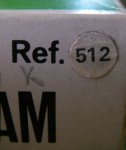
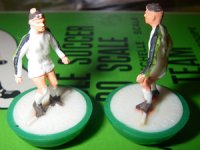
Perhaps the one unique team from this flyer is 512 Borussia. This is clearly a Borussia Moenchengladbach kit, although the flyer only refers to it as Borussia. From the pictures I'd previously seen of this, I assumed it was ref 221 (without the shorts trim), as that was Borussia M'gladbach's kit in the British catalogues of the time. However, the team is actually an earlier Borussia kit featuring both black and green stripes on the sleeve. This had been seen in European competition in the 1970s. English collectors may notice a resemblance to reference 199, although there are enough differences (collar, badge, shorts trim, sock trim) to call it a unique kit.
Thanks to Alessio Vergani and Carlo Perugini, who e-mailed in with completely different boxed teams of this reference within days of each other.
Another team that doesn't tie up to the British catalogues is 522. This was San Diego Toros, and it was obviously spotted that the colours were identical to reference 77*. The alphabetical list in the 1979 UK catalogue quotes San Diego Toros as kit 77, so that's all quite logical. Mind you, the two "San" teams are further confused in the 1981 catalogue, Things are fine in the numerical lists, but the alphabetical list has San Diego Toros as 259, and doesn't mention the Earthquakes at all. Opps. Actually, this team is wrong anyway. The San Diego Toros only played in the NASL in the 1960s. The 1976 revival of the team was called San Diego Jaws. The kit is pretty close, although you could argue that it was more of a yellow (so either ref 6 or maybe 211). There was a Miami Toros, but they played in maroon.
* The Italian heavyweight book has 522 illustrated to highlight that the kit was painted with shorts trim. It's a minor difference, but you could argue that it makes the team unique.
The Hybrid Figure Era.
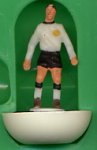
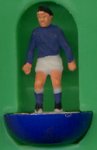
With expanding foreign markets and an ever-growing range of complicated kits, it became clear in the late 1970s that Subbuteo Sports Games Ltd would no longer be able to cope with demand using its old hand-painted techniques. There needed to be a way to machine paint the teams, but there was no way to do this with the heavyweight. So a new figure had to be created. This figure was, of course, the zombie.
These seem rushed into production around 1977 because early versions don't even have "Subbuteo" written on the bases. I guess they successfully filled their primary demand meeting role - for instance zombies were the first teams to be sold in Greece. But while the zombie is a nicely balanced figure and the peg bases is a good idea, looks-wise, they are definitely a step backwards from Charles Stadden's delightful heavyweight design.
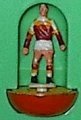
Certainly the Italian punters were very unhappy with this new figure (I'm not saying anyone else was delighted either!). Anyway, Edilio Parodi decided he could make his own heavyweight figures. But I guess his bases were coming from England, and the new ones would be designed for peg fittings. So Parodi produced a hybrid figure - a Stadden style heavyweight footballer on a peg. Problem solved. Well almost. Parodi had his hybrids produced by a Portuguese factory (Juao Ruano), and the results were not fantastic. The casting was poorer than the proper Subbuteo figures, and the figure ended up with either a big head or a little one, both of which look fairly comic. See the International Team Production page for more details on Portuguese production, which can use these figures, but their teams are usually in a poor lightweight casting. Of course, the arrival of the lightweight a year or two later made these figures obsolete in any event.
Arturo Parodi (Edilio Parodi's son), said in an interview with Subbuteoworld, said that the hybrid was produced for "a short period, maybe one year", but it was not a big seller.
 A
heavyweight figure on a peg (502 Roma 1980 version - see below)
A
heavyweight figure on a peg (502 Roma 1980 version - see below)
A good example of this new figure in action is the 1980 Italian catalogue. This has a "nuovo squadre 1980" page which features the hand-painted new British lightweights of that year (323-329) plus teams 501-504 and 506-509 in the hybrid figure as shown here.

Quite why Parodi decided to reuse the 501+ numbers that he had already used in 1976 is another little mystery. The range does look like a continuation of the 1976 releases, as it has a new South American side, some extra Italian minnows, and away kits for the big three Italian teams, Juventus, Milan and Inter.
These teams appear in the British catalogue from 1981. There are a couple of important points here. First up, references 505 and 510, which are missing from the British catalogues, are not shown here either. So were they in an earlier Italian catalogue, or were they not produced? Also, while the colours are not too good on my picture, one kit is clearly different than the British version. 502 is Roma 2nd in 1981, but here it is "Roma Nuova". A mainly red team, rather than the white one of later years.
*The only clue to reference 505 is in the aforementioned British 1981 catalogue. It is not illustrated, or in the 1-509 listing. However, in the alphabetical listing, there is a listing for Argentina (No. 2) next to the number 505. That's it. It isn't listed as a second kit, and is the only name in the listing that has a bracket with a number in it like that.
Just as a historical point, Pistolese won promotion to Serie A in 1979-80, while Monza were sixth in Serie B that year. Cremonenese were in Serie C/1 A. They had been in Serie B earlier in the 1970s.
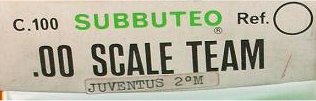
It should be noted that many of these hybrids were sold in named boxes. However, these boxes are not the usual small "splash" boxes of the UK production, as they are slightly bigger. The Portuguese boxes are a similar size, and have the same plastic interiors. This suggests that the boxes were also produced under licence in Portugal. The named boxes are usually on typed labels, which contrasts with the printed names on the Portuguese boxes. The writing on this Juventus box suggests naming in Italy.
It is not clear how many hybrids were produced, or what reference numbers they were painted onto or sold under. The Italian catalogues of 1980 and 1981 show all the available team colours painted onto various players - lightweights, hybrids and heavyweights (note - no zombies!). You can scan these catalogues, and pick out the hybrids, but there is a feeling that these were just single players painted up to produce a catalogue. The 1981 range beyond 322 are painted onto a mix of players - but the heavyweights are all black haired, and mostly on white bases, suggesting a quick paint of some reference 21s.... The NASL range has been seen in this figure, but again they have an Italian origin.
I might start a hybrid gallery here, if anyone has weird ones. I own a standard reference 34 Juventus (not the badged special), and I have a Barcelona picture in my files. The Subbuteoworld magazine from 2004 illustrated an interview with Arturo Parodi with pictures of a 281 Portugal, and a 175 Haiti.
As I've suggested above, the hybrid figure also appears in the other big Parodi contribution to the Subbuteo back catalogue - the C100s teams. These were special hand-painted teams with extra trim and badges, sold in colourful boxes (see below).
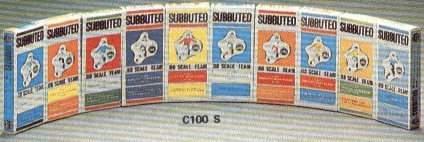
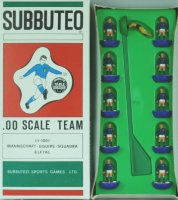
These teams feature in Italian catalogues starting with the 1976-77 version at the top of this page, and lasting at least a decade. However, only the coloured boxes seem to be illustrated in the 1970s. When Parodi started to do their own photographs of the team range, they pleasingly included these sides, which gives us an accurate record of their later production.
In the Arturo Parodi interview with Subbuteoworld, he stated that these teams were first produced around 1974. He said "They were specially painted with more detail, they were painted in England and the quality of painting was ok, but not as good as we would have liked".
The catalogues neatly divide the teams into National sides and Italian sides.
National Sides.
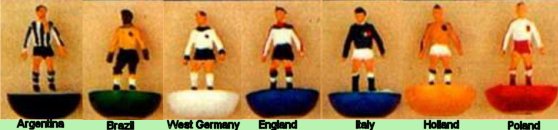
This first picture shows the teams as they appeared in the 1981 catalogue. At this point there were only six teams, and they were all either heavyweights or hybrids. (it is hard to tell with the angle of the photograph, but the Argentina could be a hybrid).

Here are the teams as they appear in 1982-83. France, Spain and Uruguay have been added, but all those are machine-printed lightweights. Their first arrival in this range might explain why these lightweights have badges, which wasn't a regular Subbuteo feature at the time.

This final run of teams is from a mid-1980s catalogue, and you can see by this time that all the teams are just the standard lightweights of the era. However, you can really see how teams like Holland and Poland were based on the original heavyweights of the special series.
The Special series remains in its own coloured boxes throughout its run, however, the later lightweights do change to the smaller size of lift-off lid, and have plastic inserts.
Italian Club Sides.

Here are the Italian teams from the 1981 catalogue. Lots of unique teams in this run, with the Fiorentina (here in rare pink outer) being the highlight.

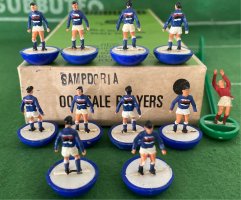
As with the national teams, my second picture comes from the 1982-83 catalogue. Here, Sampdoria is the only new arrival with a lightweight figure. The others are clearly the same chaps as before, but as they are shot from a better angle, you can clearly see that Milan and Torino are hybrid figures rather than heavyweights. Pleasingly though, both were produced in a true heavyweight figure.

Here are the machine printed lightweight versions from the mid-1980s, and now all the teams have little dot badges. Nice to see machine prints for teams like Fiorentina and Lazio, that don't match those in the usual run of numbered teams in the UK....
... they might have been pencilled in though. As explained on the Teams 401-500 page, the Genoa with badge has been sighted in a reference 417 box, and the badged France has been seen as 395 (although it eventually became 461). There are enough missing reference numbers in the 390-420 range to suggest that there may have been a plan to transfer all these teams to the main range circa 1983. As it is, some of these teams did use numbers in this area (Uruguay 397, Sampdoria 398, Brazil 410, Poland 412, Italy 415 and Holland 416).
It looks like we'll never know. It is also worth pointing out that many of the reference 93 Roma lightweights in the UK have the white badge (it isn't printed, it is just a gap in the red).
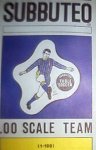
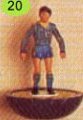 Verona (ref 615)
possibly the final special?
Verona (ref 615)
possibly the final special?
A final special team was produced by 1986, and that was Verona, produced to celebrate their surprise Serie A win in 1985. This team also found its way to the normal number range though.
Miscellaneous anomalies:
There seem to be plenty of these among Italian production. Here are a few that I've heard about. If anyone can confirm any of these points, I'd like to hear from them.
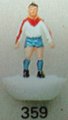 359 - the final Italian heavyweight ?? (or was this just painted on a reference
21 for the catalogue?)
359 - the final Italian heavyweight ?? (or was this just painted on a reference
21 for the catalogue?)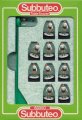
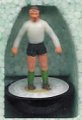
That's it for anomalies for now, but if anyone has seen any different ones, then please send them in.
Time to choose another destination I think.
[ Main Page | Previous Page ]