| Peter Upton's |
Subbuteo Tribute Website. |
The Illustrated Accessories List. |
|
|
|
Set N - Set ZZ |
Set N (metal version):
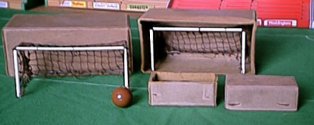
Two fully assembled deluxe goals.
Manufactured in strong copper wire, with the posts
and crossbars in white acetate tubing and covered by real netting.
The picture shows the early goals (and balls) with the plain card boxes they were packed in. See the picture of Set Q for a side-on view of these goals. The metal goals do not have any lower support bars, but you won't notice, because the metal makes them pretty sturdy. On the above set of goals, the nets have been fixed to the posts with black cotton.
Set N
(plastic version): Two fully-assembled deluxe goals.
Manufactured in strong white plastic. Covered by real netting.
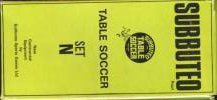
A mainstay of Subbuteo, these were the standard goals supplied in every Club Edition from their introduction in 1959-60 until Hasbro took over production in 1996. The goals had brown nets in the 1960s and early 1970s, and then switched to white nets around 1977. After 1983, when the goals had ceased as an accessory, they still appeared in club editions, but with bigger, less well fitting nets (probably borrowed from the other goals of the period). These were originally still white, but later goals switched to a rather nice red, or even white and green stripes.Another set to feature this goal was C189 the skills trainer in 1982 (because this is the goal that the target board was designed to fit).
The plastic version fitted the OO scale range very well, but although there was an abortive attempt to bring them into the OO scale range (albeit with plastic nets) as C109 in 1963, they actually remained on this letter until 1976, when the older range ceased. They then switch to become C148 (or C148N) in the 1977 range tidy. They seem to have just missed out on a 63xxx number, having been phased out as an accessory in 1983 (there were plenty of other goals in the range by that time)
They may be called "strong plastic" in the above description, but I still broke many of these goals in my youth, and bits of goal, and broken supports are a common feature of second-hand sets. A picture of this goal can be seen below with Set NN.
Set NN arrived in the range with the small balls in 1952, and were designed for use by "experienced players". Not much use for me then - I need the goal to be as big as possible. This early metal version cost exactly the same price as the bigger goals (5s 3d at that time). and lasted until 1960 or 1961.
(plastic version): Two smaller goals.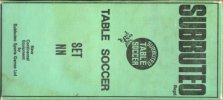
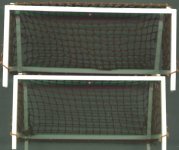
The interior size of the small goal 111mm x 54mm, compared with 125mm x 60mm for set N, and hopefully the scan above shows the size difference between the sets. Sensibly, both goal types are the same depth - 50mm - so the ball will still stick in these smaller goals. Apart from the depth, all the dimensions seem to be reduced - the posts are thinner, and even the net seems to be more delicate. Thanks to Eddie Lang for supplying these goals for the website. Like set N, these were first produced in 1959-60, and survived to become C149 in 1977. However, they only existed for a short period on this new number, and were absent from the 1979 range.
Set O: Packet of eleven football player-figures.
Stamped out in flat plastic.
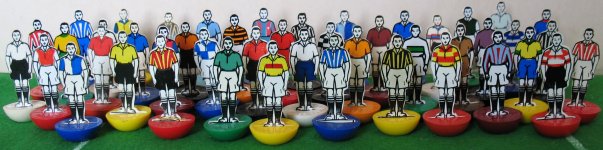
I assume that these celluloid figures were designed to replace the card ones, and they were in the range by 1949. However, the big cost difference kept the card sides popular, and the two versions actually ran in tandem for the whole history of the flats (although the celluloid did out last the card ones by a single year - their last catalogue appearance being 1972/73).
Interestingly, the plastic figures were never sold as a complete useable team - you needed to buy a set of bases (set E) in an appropriate colour before you could use them (and if you then wanted a box for them you could buy Set S). It does seem strange that the card figures were sold with bases, whilst these never were.
Set P: Referee and two linesmen.
In flat plastic mounted in black bases.
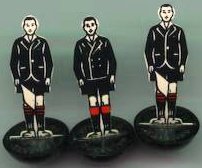
These are the celluloid version of Set L, and like most of these sets, they were already being offered for sale by 1949. This set is one of my favourite Subbuteo items. Note that the ref had a double breasted top coat, and the linesmen had single breasted. That's status that is! The red sock tops were a nice touch. The figures were machine printed, and the sock tops seem embossed on the top. The set hung around until 1972 when they cost 15p and where their FLAT status was stressed to stop confusion with the OO equivalent.

Set Q: Goal-holding device - For use with set N.
Set QQ (Q2): Goal-holding device - For use
with set NN.
Set Q3: Goal-holding device - For use with set C122.
Scientifically constructed for firmly fixing both goals to the table... provides for immovable goals without damage to the actual table surface.
Early Version (1940s-1960's)
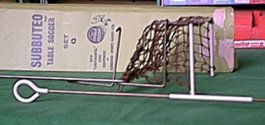
I'm very grateful to Gordon Watt who provided this earlier version of Set Q. Sold in a long, thin box that is actually longer than my scanner (!) this set consisted of two pairs of long metal rods. On each, a hook clips over the top bar on the side of the goal, and a loop in the metal fixes around the rear corner post of the goal. Then you bent the end of the rod around under the table, using a movable white plastic sleeve to prevent damage. Another strange, but effective invention by the Subbuteo design studios. This set is designed to fit the old metal goals, and the metal/acetate construction nicely matches these goals. However, they also fit on the plastic Set N - and were produced alongside those goals in the 1960s. Set QQ was also produced in this version to hold the metal version of set NN. Set Q was established in the 1949 range, while set QQ was added in 1954-55, a couple of years after set NN arrived. The two sets remained in the catalogues until replaced by the plastic versions in 1971.
1970's Version
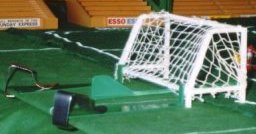
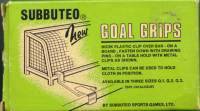
I tend to play Subbuteo on a large piece of hardboard laid on the floor, and using these later goal grips works a treat. They are at their most useful when I'm using the goalkeeper training wall, as I need one hand to hold the goalie, and one to flick the ball, and this doesn't leave anything to hold the goal with, except the goal grips - or my feet. They simply consist of two green plastic hooks with long flat handles. The hooks clip over the bar at the back of the goal, and the handles are clamped to the tabletop with a standard metal clip.
The new sets arrived in the 1971 catalogue - with the new Set NN holder being renamed from set QQ to set Q2, There was also a longer set called Q3, which was introduced to hold the C122 goals. However, these new sets were short lived, with none of them available by 1975. This was probably because no goals produced after C122 had a back bar.
Set R: Material for treating goals
So the ball stays in the net after even the hardest shot. A simple idea and most effective.
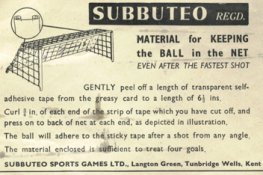
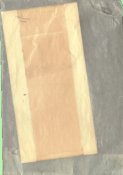
I've been advised that this was some type of sticky tape, about an inch wide, which was stuck on the bottom of the inside of the net. Thanks go to Chris McKay for this info. Jools has now sent me an illustration of this set, complete with instructions for its use. I've had to reduce the size of this picture, but hopefully it is still readable. I imagine this item was effective as long as you hadn't got as far as chipping the ball. And I have to wonder how long it would be before the tape was covered in fluff and bits of the pitch!
Set S: Team holder carrying box.
Designed to hold the player figures, one ball and goalkeeper manipulating wire. Manufactured in red, royal blue, light blue, black, white, old gold, green, tangerine, maroon and yellow.
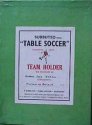
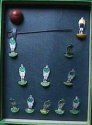
Another item produced in all of Subbuteo's favourite colours. The box was designed for the old flat players of course, who were usually sold separate from their bases, and were never actually sold in a box. Illustrated above is a green team inside the green box. As you can see, the box is a very nice item, and although they are not actually very big, it still looks as if you could store about four teams in it of you bunched the players up a bit more. The position of the players looks a bit eccentric to modern eyes, but it represented the 2-3-5 formation of days gone by. Most serious users of flats would have turned the formation around, and had the five (as a minimum!) as a defensive line.
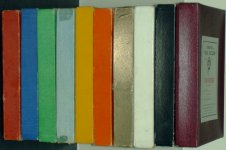
As with the bases, it took a few years for the full range of boxes to be established. 1949-50 had red, blue, white, black, tangerine and green. In 1952-53 the tangerine was replaced with old gold. Tangerine was reintroduced, and the full range established in 1953-54.
Set T: Six pitch flags.
These are manufactured so they do not obstruct play at the corner touchlines.
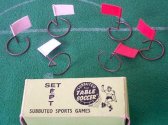
These early flags were again in the 1949-50 range, and have rather cleverly designed bases. They continued to be sold until the arrival of the plastic flags with ball raising bases in the continental range (C117). That set arrived in 1969, and set T was gone by 1970. The big advantage of these older flags is that they are much more difficult to break - but they probably hurt more if you kneel on them. The picture above is a reduced version of one sent to me by Steve Bowes (thanks Steve). The box is interesting because it is also designed to hold set F (three balls), or set P (the referees). This gives some indication of the size of these flags - they are about the same size as a Subbuteo figure, both in height and circumference.
Mike Henderson has kindly sent me the instructions for these flags, which quote a British Reg. Design of 859418. The instructions are a little different than I expected, so I've quoted them here - "Insert the point of the wire post into the underneath part of your playing pitch so as to appear just outside the actual corner or half way line on the surface of the field of play. Slide the plastic flag on to the top of the post. See that 3 red flags are on one side of the pitch and three white flags are on the opposite side. The posts do not rest on the field of play with the circular base showing."
Set U: Four fixture cards.
Each card has space for match results, half-time scores, scorer's position etc.
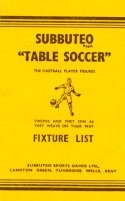
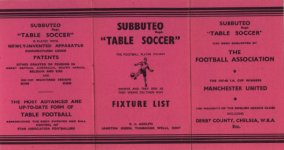
Scorer's position? These came from the days of set positions like "outside half", and "inside left". They are the final product in the 1949-50 range, and one was included in the sets of the era (in a rather nice purple as featured above). Luckily, the other side where you write the stats was a more subdued colour. The fixture card continued to feature in the full sets right through the 1950s and 1960s. The yellow version above came from a 1967 set, and is a more reasonable colour. However, notice that this newer version keeps the original 1940s "kicking figure" logo.
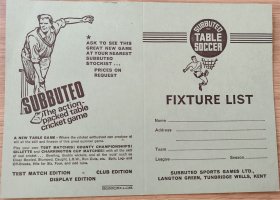
The item was finally revamped in the 1970s, complete with the new logo. Again, this was produced in at least two colours. There is a green version with an advert for Subbuteo cricket on the reverse, and a white version with an advert for Football Express. The (pale) green version is shown here, with the final version illustrated under C150 - the code the set was given in the 1977 re-number. Like many of the other flat sets, this one only survived for about a year on the new number.
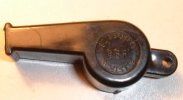
Set V: Miniature referee's whistle. And to drive your friends nuts. First arrived in 1950, and
survived to become C151 in 1977. Removed as a single accessory in 1979, it was incorporated into that
year's new referee's kit (which was C166), so you could continue to get the
whistle until that set too was cancelled - in 1984. Thanks to Brett Silberg for sending me this picture. Set W: Automatic bell-ringing time keeper. Stefano Montecchiesi sent me this Italian catalogue illustration of set W. In the 1976 price list it
was the second most expensive item at £2.80. To compare, the then new stadium grandstand was £2.95, and two floodlights £2.20. For that reason I was expecting something a little more grand than the illustration shows. I used to use an old white kitchen timer for Subbuteo matches, and it was actually surprisingly similar to this item. Since I wrote the above, I've been advised that the reason this
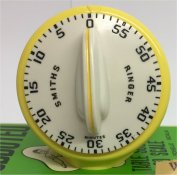
looks like a kitchen timer is because it is one! It is simply a re-boxed Smiths
kitchen timer of the period. They even had Smiths printed on the face (so check
your mother's kitchen, and see if she has one). It was available in a number of
different colours, I've seen red and green, and even in different styles -
although the one shown is the most common.
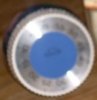
This (sadly blurry) photograph shows a different
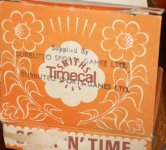
form that the Smiths kitchen timer could take. The proof that this "timecal"
timer was also sold by Subbuteo is shown by its box, which is
stamped "supplied by Subbuteo Sport Games Ltd".
For the control of important matches.
Scientifically correct to a second, and adjustable to any period. The bell rings at half-time and full-time.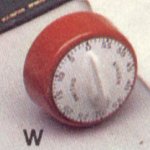
Set X: Croid glue.
Large tube for use with sets G and O.
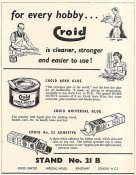
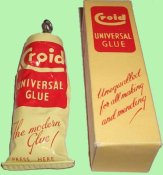
Figuring they might as well cover all bases (possibly literally), Subbuteo began to offer a recommended glue for sale in 1952. That way, you were less likely to melt the players, or have them fall out the base at inappropriate moments. The set was designed for gluing both card and celluloid flats into their bases, and ceased when they did in 1973. However, I'm sure Subbuteo could've marketed a glue to mend all the plastic players, goals, balls, and flags that were broken down the years.
1950s Subbuteo expert Ashley Hemming has done some research on Croid glue, and has kindly provided pictures of both the product, and a 1954 advert by Croid Limited, a glue manufacturer based in London. These are shown above (apologies that the advert is so small. I'll try to fit it in somewhere else in all its glory. "Croid universal glue" was recommended on the small instructions that came with the celluloid players from 1952 (duroflex was on the instructions prior to this). Croid was advertised as a glue "for every hobby". Whether they approached Peter Adolph, or whether he approached Croid Limited is unknown. Perhaps they met at a trade/hobby fair. Either way, Peter Adolph obviously decided it was another good cross-selling opportunity, and added their product to the Subbuteo range.
Set Y: Surround apparatus.
Keeps the ball on the table after it has crossed the goal or touchlines.
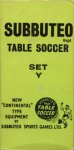
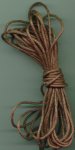
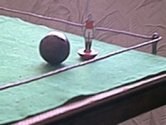
This is the very first pitch surround first seen in 1953-54. The set consisted of a length of twine, and six metal clips - four small ones for the corners of the pitch, and two larger ones for the half way line. The twine passed through the eyes in the clips, and when it had been passed right around the pitch it could be tightened and tied at one corner. The middle clips are bigger so you could use the set with the type of old dining table our family owned (and still owns!), which had a thick centre with thinner pull out flaps.
In keeping with the other accessories of the period, the clips were made of copper wire with white plastic tubes covering the ends (see the early versions of set N, Set Q, and C110). Also like the rest of the 1950s range, set Y was practical rather than showy. The game was not really being sold as a toy in this period.
In practise, the set is a pain, as it proves hard to get the clips to fit tightly to the table. The instructions suggested using card or wood to wedge them. I guess they could be bent to fit the table - but I'm not going to try this with a thirty year old set... Once the clips were fixed you can try to get the required tension in the string (without pulling it off the table). The set was still in the 1969 catalogue, but the red fence had been introduced to the continental range in the mid-1960s, and this was much easier to use. Actually though, the catalogue that said farewell to Set Y was the same one that says hello to the classic green fence (1971)
Set Z: Score Recorder.
A useful gadget for visual record of fluctuating
scores. No more arguments about those "added" goals.*
Early Versions.
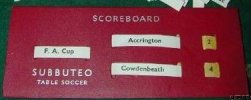
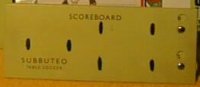
*Sadly, fifty years later we still have arguments about those added goals at the Worthing Five-Star league (you know who you are!)
The first scoreboard produced for Subbuteo was made from cardboard, and had arrived in the range in 1953-54.
The original version was red, and of simple construction. The board folded at the top, and stood on the two ends. A thin piece of black ribbon stopped the board opening too wide (and therefore lying flat). The numbers on this board were on a long looped strip of card, which simply pulled through the board. It is hard to find versions where this mechanism has remained in good condition. The board also had three slots, which allowed for card names to be entered for the two teams involved, and the competition name. This format remained unchanged through the brown scoreboard shown below, and onto the Stadium scoreboard (C158) which survived into the 21st century.
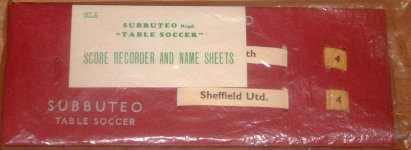
A later version was the green scoreboard. This version had the numbers on a rotating circular piece of card fixed to the board with a pin. It is assumed that this scoreboard is the "new type" introduced in 1961-62. However, there was a big price jump at the time, and there does not seem to be anything between the green and red scoreboards illustrated above to justify the 1961 increase.
Late Version 1969-77
A completely new, fully working accessory presented in big stadium style. Insert cards with names of English and Scottish clubs.
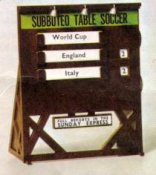
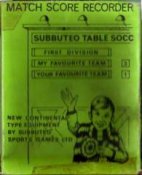
The lovely brown scoreboard arrived "new" in 1969-70. The difference between this recorder and the previous ones clearly shows the shift in emphasis in Subbuteo designs that started with the arrival of the OO teams. The early figures, and the A-Z range produce an abstract game that is similar in feel to snooker, or table tennis. With the OO scale accessories, Subbuteo finally developed its own distinctive look. The idea that the game could become a scale reproduction of a real football game - with stadium accessories that wouldn't look out of place in any OO scale model village, or railway layout - was a good one sales-wise (although a lot of older players didn't agree, preferring the original tactical game). The brown scoreboard is a classic part of this new look. The small "Sunday Express" advert, and the little grey lights are delightful touches.
As the red fence had not become a new Set Y, it is strange that the new scoreboard did not go straight into the Continental range. Especially as the box calls it the "new continental type". However, it got there eventually, usurping the Subbuteo tie to become C115 in the early 1970s. Even then it was still referred to as C115Z for a few years. It lost the Z suffix in 1977, but was replaced shortly afterwards by the black scoreboard still used today. Thanks go to Joe Butt for the scan of the rather cute early box.
Set
ZZ: Name sheets.
Individual names of all English and
Scottish clubs for use with set Z.
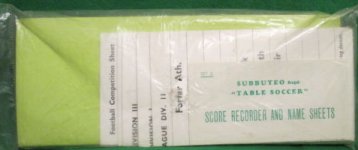
This set is really just a small addendum to set Z. It arrived with the "new type" green board in 1960-61 at 8d, and was basically a chance to buy the card name sheets separate from the scoreboard. I am not sure whether this was the first appearance of team name sheets, or whether they were just an update. I assume that the set was produced so that owners of the original Set Z could buy new sheets. If this was not the case, I cannot see much of a need for the sheets without the board, and this set can not have been successful, because it was dropped fairly quickly.
The name sheets produced alongside the scoreboards continued to be tweaked and updated. In the 1960s each league was printed on a different card (i.e. Division 1, Scottish Division 2 etc). Obviously these were altered periodically to match promotions and relegations. Ashley Hemmings has a green scorboard with tables dated to 1964, and I have the original brown scoreboard (in Set Z box) with the leagues for 1969-70. This was probably the last year of the divisional layout, before the name sheets were amended to a single alphabetical list. I assume this to be the case, as 1969-70 was the final year that Bradford (PA) were in the league, and yet they find themselves carried into the alphabetical version. Oddly, the alphabetical version was amended in the 1970s as Barrow were replaced by Hereford, and then Workington were replaced by Wimbledon, but somehow the Bradford/Cambridge switch never happened....
I think the final release of the scoreboard was the one that featured the 1978 World Cup name sheets, which (like the 1974 World Cup before it) were printed in red.
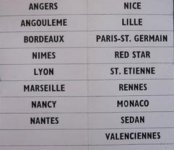
Sheets were also produced for other countries, such as France, Holland, Germany and Belgium, but none of these were sold separately to the scoreboard. Mind you, Subbuteo Games were a small friendly company, and I expect they would have provided them if requested!
The new look "continental style" score recorder is an appropriate place to conclude my look at the early Subbuteo range. If you'd like to move into the classic OO era of accessories then choose from the pages listed below.
[ Main Page | Previous Page | Next Page ]