[ Subbuteo
Menu ][ Teams ][ Accessories
][ Index ][ Links ]
| Peter Upton's
|
|
Subbuteo
Tribute Website
|
|
The Illustrated Accessories List.
|
|
Part 2 The Continental Range.
|
|
C121 - C139.
|
Hmm, I think all the page and part numbers are getting confusing. Oh well, best
if we dive straight in...
The Accessories.
C121: Three match balls.
Moulded in yellow plastic with black
spots. 19mm in diameter.
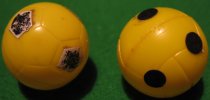
This was the first set of balls produced in a medium size between the previous "standard
ball (set F), and the small ball (Set FF). This 19mm ball then slowly became the
standard size ball. I'm not sure why the size was changed. I suppose the larger
ball was originally designed for the flat figures, and this was the first one designed
for the OO scale teams. It is easier to score with the smaller ball, which might
be a good thing. This set arrived in 1969,
and was also the first ball to use stickers.
The set trundled along, making it to 61121 in 1984, before finally bowing out around
1986. Basically it was swamped by all the new advertising balls coming out at that
time.
As with all Subbuteo there are lots of minor (some would say dull) variants to this
ball. The version shown most often in the catalogues is of a panelled ball with
small round black spots stuck on. This was a "two panelled" ball, matching the look
of the older sets (ball on right of above picture). This was followed by a hexagonal/pentagonal
design of ball (also used for C127) with matching spots. Do I expect the different
types of spot to appear on both type of ball? I would think so. The stickers can
affect the way the ball rolls, although the ones on this ball are not too much of
a problem. This was solved on the mid-1980s ball by having the spots painted/printed
on. This looked more effective too.
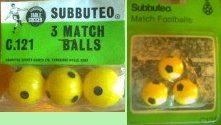
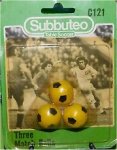
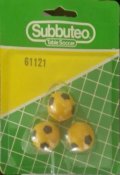
- Pack types:- As with all 1970s balls, this was originally sold in
a bag with header card. Again like the other balls, it was placed into a bubble
pack in the 1980s. All three backing cards have been seen with this ball on
them. The later the card, the more likely the balls are to be printed.
- Other Ball "C" numbers are C127, C144, C145, C167, C183, C190, C191 and
C205. See also the "61" range which is stuffed full of balls :-).
C122: "New-type"
goals. (Fixture-type goals).
With rounded posts and crossbar with
real netting mounted on green bases for fixing and holding.
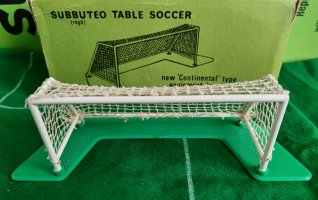
These goals used the same bases as the rugby posts and arrived in 1969. I'm not
sure which came first and perhaps they were designed specifically to share a base.
While rounded posts gave a modern feel, and the bases definitely help stability,
these goals were not actually very different from the standard goals of the time
(Set N). They were not without problems. The bases are really rather big and cumbersome,
although I suppose that makes them easier to hold. The main trouble was how flimsy
they were, especially the back-bar. The boxes turn up frequently in collecting circles,
but finding an undamaged pair of goals within is a bit trickier.
A really flash redesign of the goal
had to wait until C130. The early catalogues and boxes refer to this set as "new-type"
goals, but this name obviously had to change when they weren't new any more. Hence
"fixture-type goals". Hardly an inspiring name folks. They did not appear in the
1978 catalogue and their replacement, also with rounded posts, was the Tournament
goal (C154).
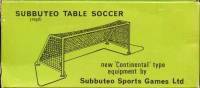
- Box types:- The box shown at the top of this section is the only
type I have seen, although they come in various shades of green. I have seen
pictures that suggest a slightly different shape of box (wider?), but I'm not
sure.
- Other goal "C" numbers are C130, C148. C149, C154, and C181. Lots more goals
were introduced in the "61" range.
C123: Live Action Goalkeepers.
The lifelike new accessory you have
been waiting for. He dives, twists and punches at shots from every angle.
Suregrip "Continental" plastic handle gives more effective goalkeeping.
Yeah, right. The optimistic description above is from the 1969 catalogue,
when these 'keepers were new. If you are imaging a sophisticated device to "punch
at shots from every angle", you are out of luck. This is an ordinary keeper with
a coiled metal spring between the 'keeper and the green plastic handle. Does it
work? Well I was disappointed with my set, when they didn't turn me into the greatest
'keeper ever. I found the loss of stability in the handle outweighed the benefits.
Plus, I'm sure the spring yielded to powerful shots with the goalkeeper just helping
them on their way. So a short-lived novelty item? No, actually a long-lived one
with this item surviving right up to 1995. So either they were usually better than
the ones I had, or generations of players were fooled into buying them. I suspect
the latter.

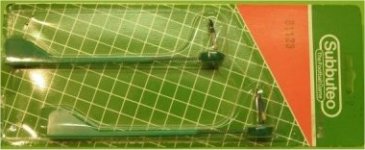
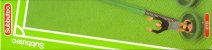
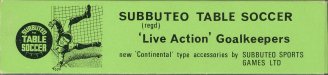
- Box types:- The original 1969 box is the same size as the other goalkeeper
boxes of the era, but more detailed, actually naming the product on the sides
(as usual, the reference number is on the end flaps. There would be a hobby
crest version, but it isn't illustrated. The monochrome logo version is though.
From 1983-90 the set was in a bubble pack, after which it was boxed
once more, in the corner pitch box (both shown).
- Obviously the goalkeepers in this set mirror those on the standard rod (see
C102). So the leaning back one is common in the 1970s.
- The lightweight goalkeeper switched to a peg circa 1986, but these remained
on a bar until 1989-90
C124: Training Kit A. Target Board.
...with numbered holes... Improve
your goal-scoring potential.
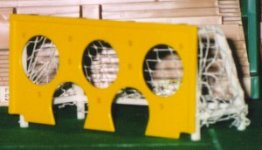
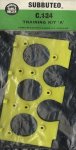
The first of a set of three training items for people with no friends, which were
introduced in 1969. In fact, this was the item that made many players think "okay,
so I should be able to chip the ball off the ground". Saying and doing were two
different things though... Even ignoring the holes at the top of the board, it was
still difficult to get a ball though it. It has also been pointed out that the holes
are not in the best positions anyway. Surely you would want to score in the bottom
corners? C124 left the range in 1978, but made a stunning comeback (or something)
a few years later in the Skills Trainer set
C189. Obviously they still
had lots in stock......
- Pack types:- This accessory was usually sold in a bag, with a header
card.
C125 Training Kit B. Goalkeeper
Rebound Wall.
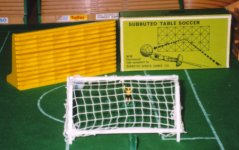
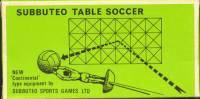
There is nothing interesting about this in any of the catalogues,
and none even bother to illustrate it. It is however, one of my favourite items.
A big yellow plastic thing, stuffed with rubber bands, it really is pretty successful
at doing what it set
s
out to achieve. The way to get the best out of it is to load it with small, tight
rubber bands, and set it at an angle to the goal (30 degrees is a good start position).
Then pin down your goal with goal grips or whatever, because you are going to need
both hands. With one hand on your goalie, ping a ball at the rebound wall with a
finger (don't bother with a player). The ball should fly off the wall at some strange
angle, and will fly past your stunned static goalkeeper into the net. Repeat ad
nauseam....
Like the Target board, this arrived in 1969, and ceasedbefore the 1978 catalogue.
Unlike the target board, it was never seen again. (sniff !).
- Box types:- Just the one shown. Classic early 1970s illustrated box.
61125: Premier League Trophy.
This 1990's reuse of the "125" number is detailed on the
61222+ Hasbro page.
C126: Training
Kit C. Dribbling posts and passing Tee.
...has a Passing Tee which helps sharpen up those sweeping passes which split the
opposition defence, but need direction and control on the Subbuteo pitch. There
is also a set of posts for improving your control...
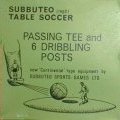
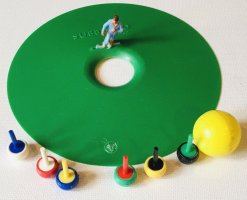
Another accessory I first saw
illustrated in Stefano Montecchiesi's heroic Italian catalogue. Hopefully,
the picture gives some indication of how the passing tee was supposed to work.
This is a circular piece of plastic about the size of the centre circle, that is
sloped slightly away from a hole at the centre The figure waiting to trap the ball
is a tracksuited player from C103. If he looks big in the photo, that's because
the dribbling posts are tiny. You had to aim the ball at the tracksuited guy really,
because if you don't give it enough of a kick, the ball rolls back down the slope.
Tends to be a bit frustrating...
An alternative use for this item is as the hole at the end of a
Subbuteo golf course. In this exciting game, the corner kick figure becomes your
driver, the 1998 World Cup corner kicker is a delicate wedge, and a normal player
is your trusty putter. Add a few house plants and a cat's water dish as hazards,
and you are ready to play.... and I really should get out more :-(
This item dropped from the range earlier than the other training
items, with its final outing being 1973-74.
- Box types:- Just the one shown. Another classic early 1970s action
illustration.
C127: Three Continental
Balls.
Moulded in white plastic with black spots. 19mm in diameter.
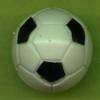

Basically, a white version of C121 appearing a year later in 1970. It's that exciting
:-) Again, the kind of vital accessory which kept going through the 1984 number
change, only to disappear in 1986 under the vast number of "advertising" balls that
were starting to appear. There are at least three versions of this ball. The original
has such deep depressions and thick stickers that it is the most useless ball ever
produced. Just try rolling one around on a flat surface. You might as well be trying
to play with a twenty-sided dice. The next one was better, but the ball was thin
and prone to breaking in half. In 1983-85 the spots were machine printed onto the
nice thick ball of that period, and that was the best of the lot.
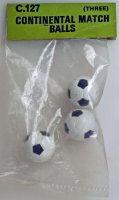
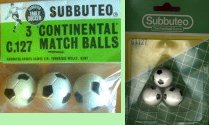
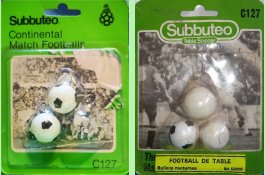
- Pack types:- Like C121, these balls were sold in a bag with header
card throughout the 1970s, and on bubble packs through the 1980s.
- Two very different header card/bag combinations are now shown.
- All three bubble packs are illustrated. The small picture is the 1983-85 61127 version, and the spots are printed on.
The earlier packs here have stickers.
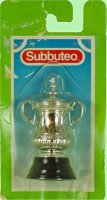
C128: The F.A. Cup.
A superb miniature replica in silver finish metallised plastic on a black plinth
in a display box.
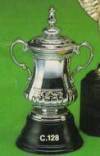
Subbuteo's first attempt at a domestic (English) trophy, and it's a real beauty.
Arriving in 1970, this was always a popular item, and it continued to be produced
until the whole accessory range finally ceased around 1997-98. Like the World Cup,
this was originally sold in an attractive display box. This also had a card support
for the lid. (How many times have players lost the lid of the real FA Cup in over-the-top
celebration?). The original box shows the trophy, but this is then changed to match
the boxes of the other trophies. It receives a couple more box changes, before being
put on a bubble pack in the 1980s. In the 1990s it returned to a box, but this had
no support for the delicate bits of the cup.
This item also appeared in the short
lived "FA Cup Pack" of 1980-81 (C180),
which included the finalists of the previous year, and a ball. The FA Cup was joined
in the range, belatedly, by the League Cup in 1980, but a league trophy didn't appear
until the Premiership tie-in in the late 1990's.
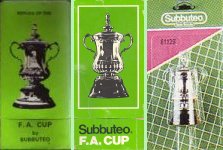
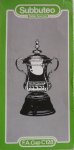
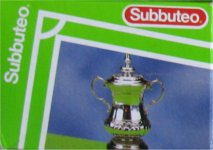
- Box types:- A long lived item that ran through all the later box
changes. The original early 1970s illustrated box is rather lovely, but I actually
prefer the hobby-crest box of the late 1970s. Both had and insert, which held
cup (and lid) for display. As did the monochrome-logo box produced 1981-83,
although this is rarer. From 1984-90, all the remaining cups were put into bubble-packs.
From 1990-95 the cup was back in a box. This was pretty basic though, and not
as good as the early display versions.
- In 1996 Hasbro put the cups back onto
bubble-packs, in a new pitch-corner design.
- Thanks to Steve Gladwell for sending a picture of the rare monochrome
box.
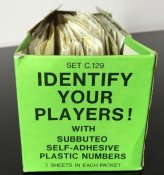
C129: Number Transfers.
Two sets (1 black-1 white) of transparent self-adhesive numbers (1 to 11)... for
identification and authenticity. Identify your players and have more fun.
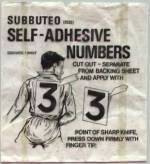
These give you the ability to blame individual players for your hopelessness - i.e.
"Oh that Ian Rush, he always jumps over the ball instead of shooting". Of course,
naming players started long before these stickers, but at least they cut down on
the crudely painted numbers that deface many a second-hand set. Having one set in
white, and one in black covered most teams in the range, although teams in stripes
were a major problem, especially Newcastle Utd. I tried sticking numbers to their
shorts, but they'd just fall off and stick to the pitch instead. (The numbers, not
the shorts). This set arrived in 1971, replacing the "lick to stick" version which
had been fine for flats, but could only be used on the bases of the OO figures.
I'm fairly sure that originally you had to cut out the numbers manually, but luckily
they soon became ready cut. The set lasted until 1983 when it was replaced by
C206 - which
had squad numbers.
- November 2017- A shop box of number transfers is now shown.
- Price lists between 1976 and 1978 actually explain (to the shopkeeper)
"1 box of 100 envelopes". Although the price is quoted per envelope (8p in
1976).
C130: World Cup Goals.
The latest type of international goals
adapted to the Subbuteo scene, complete with new coloured nets (regd. design)
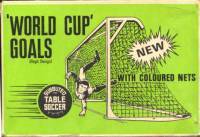
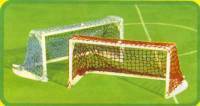
As illustrated,
the nets were one red, and one blue. These goals were new in 1972-73 just in time
for the 1974 World Cup. (Shame they didn't get the new trophy until the 1982 World
Cup, but you can't have everything). Arguably, this is where the Subbuteo accessories
first hit their stride -at least until C136. These were square posted goals, with
integral bases, and no back frames. They were quite a radical new look, and continued
to prove popular through numerous box changes until 1995. They also appeared in
the World Cup, and Munich World Series editions of the game in the 1970's. A mini
design classic.... if you overlook the fact that the nets fall off, and that the
posts end up bent backwards because they have no supports.
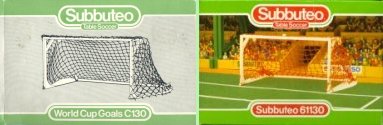
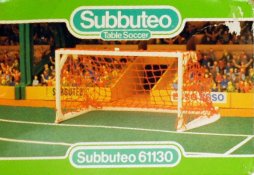
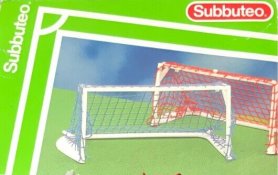
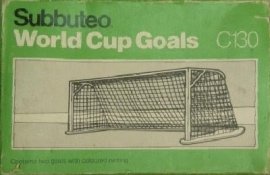
- Box types:- Introduced in a classic early 1970s illustrated box, with the
goalkeeping logo of the era placed within an illustration of the new goal. This
looks great until you study it carefully... The 'keeper is standing on one hand,
and waving his legs in the goal. Where was the starting position for his feet?
This box lasted into the Chiddingstone Causeway era.
- The long era of the original box had made me assume that the Hobby Crest
era of box didn't exist. Shows what I know! This short-lived second box is
now illustrated. The illustration on the box is terrible, and luckily was
smartened up for the monochrome box.
- I've called the Monochrome-era box dull by comparison with the original.
It's starting to look a whole lot better sitting next to the Hobby Crest
version. Green-logo and
red-logo boxes followed. The final box was the 1990s pitch
corner design, which showed both goals for the first time.
- My friend Dave dislikes this set because the nets are mismatched, and
that
looks wrong to him. I hadn't considered this before, but now he's mentioned
it I am getting bothered by it. Luckily, I have more than one set, so all
red or all blue goal nets from now on!
C131: Two "Corner Kick" figures.
Larger size, articulated, hand-painted
figures with "kicking" action on finger control base, adding practical skill, ball
control and direction to corner kicks etc.
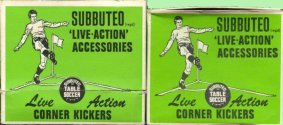
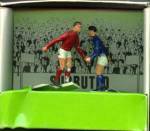
"Arrggg... Run lads, it's a giant footballer". Again debuting in
1972-73, these seriously oversized chaps were the Subbuteo rugby Conversion figures
on new bases. They were lots of fun to use, and really did help put in big floating
corners. Designed for people, like me, who couldn't chip in a corner with a normal
player, even with the ball-raising corner flags (C117). Many players also used them
for taking goal kicks, and this eventually became an official rule, with kickers
painted as goalkeepers added to the range (C201 added in 1984).
Back in the 1970's when firms could
still be small and friendly, Subbuteo would provide these figures in a range of
ten colours upon request. These teams, the same basics as available for "Football
Express", were 1,2,5,7,10,16,21,25,41, and 42. But they've been seen in many more
kits than this. Partly, this is down to Stadium Editions having three teams - with
three corner kickers painted to match. But I also think the painters strayed from
the catalogue range. I currently own a pair of Genoa kickers (ref 72) which came
in a 1970s box from an English toy collectors fair.
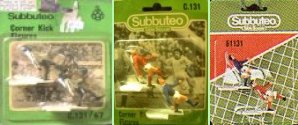
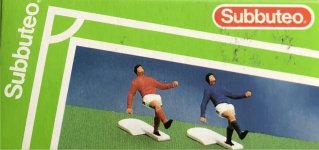
- The set lasted until 1995, when it was merged with the throw-in figures to
become 61133.
- Colours seen in box sets include Brazil, Argentina, England, Italy, Holland
and West Germany.
- Box types:- The original box was designed to open and display the
accessory in an "action" scene. The same idea was used in C134 and C135, and
was similar to the display boxes for cups. All the ten variations sold in the
1970s come in these boxes, and often these have reference number stickers on the ends.
- In the late 1970s, when Subbuteo changed the address on their boxes to the
Chiddingstone Causeway factory, this box was reduced in size slightly, and
lost the ability to stand as a display. This later box seems to have been
quickly replaced by the bubble packs. These figures have been seen on all
three backing cards. These cards do sometimes have different coloured
kickers on them, and in those cases, the reference is quoted on the card.
This seems more common in Italy, and the teams I've seen have little rhyme or reason for their
selection. The kickers returned to a box in the 1990s, in the usual "pitch-corner"
style.
- May 2020: See many of the coloured versions that were available on the
Focus On C131and C132 page.
C132: Two "Throw-in" figures.
Approx. OO scale, hand-painted spring-operated figures on finger-control
base. Enables you to place the ball where you want it.
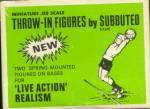
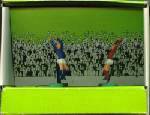
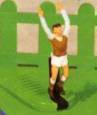
Always the companion set to the corner kickers,
and introduced at the same time. As a kid,
I admired these, as they were the correct scale and really looked the part. However,
I never really mastered them, as my finger and thumb generated back-spin which sent
the ball back out of play, or straight up in the air. Like the kickers, these were
available in the 1970's in a range of ten colours. Note the Arsenal kit (ref 16)
in the illustration. The set had one redesign which removed the metal clip and
made them simpler to manufacture. The new plastic bases seem to play just as well
(or maybe just as badly) as the old ones.
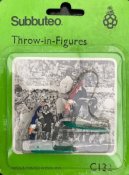
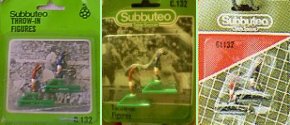
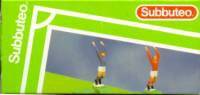
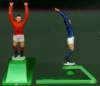
- Box types:- The original throw-in figure box was similar to the corner-kicker
box, but was smaller, and the tray slid out sideways. There was no display feature.
This meant that the box did not change into the Chiddingstone Causeway era.
The throw-in figures then appeared in the three bubble packs of the 1980s, before
returning to a box (of the pitch-corner variety) in the 1990s.
- The metal clip bases survive into the first bubble pack (which is how I
received my first set).
- The later plastic bases exist in all three bubble pack types.
- As with C131, many of the coloured versions of this item
are on the Focus On C131and C132 page.
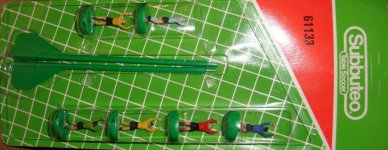
61133: Two corner kickers and
two throw-in figures.
This 1990s double pack re-uses the number
given to the interchangeable goalkeepers below. It is detailed on the
61222+ Hasbro
page.
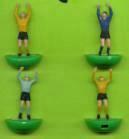
C133: Six Interchangeable goalkeepers.
Four diving, and two crouching goalkeepers, hand painted in yellow,
white, black, green, red and blue, with two controller rods for swapping over. Essential
for "international" matches.
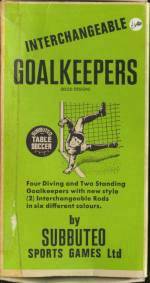
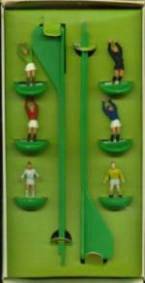
Essential for international matches? How so Mr.
Catalogue Writer? More essential for people who broke
as many keepers as I did. (You've probably realised how clumsy I am by now!). The
description above is from their first catalogue appearance in 1973/74, and the
box also highlighted the fact that the goalkeepers were supposed to be "six
different colours". These coloured shirts were paired with white shorts except
for the black shirted keeper who wore an all-black outfit. I assume this was a
reference to legendary Russian goalkeeper Lev Yashin who favoured this
combination (and might be why the international matches was mentioned).
Later catalogues refer to this
set as being in "assorted" colours, and certainly many variations exist.
From my personal collection, I would suggest that the leaning back diving
goalkeeper is far more common than his more useful upright rival sadly. Even in these
early sets, the colours are spread randomly across the figures, so you are as
likely to get an all black crouching 'keeper as a diving one. Although the bases
are unique to this set, the goalkeepers are not of course. So the diving
'keepers are probably taken from taken from those painted for boxed teams,
whereas the crouching 'keepers were probably only being painted for this set and
their own C105. In practice, this means far more variation in crouching 'keepers
than diving ones. I always hesitate to say "all" with Subbuteo, but
the diving goalkeepers have sock colours that match their shirts, whereas the
crouching goalkeepers see all sorts of versions. In a representative group that
I own, there are green shirted 'keepers with green socks, white socks with green tops and white
socks with red socks. The boots are not always painted on crouching 'keepers.
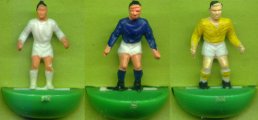
In addition to that, all three variations of crouching
goalkeeper appear in these sets, and often you'll get two completely different
ones in the same set. Note that one of the crouching goalkeepers in the set illustrated
at the top of this section is a real chubby fellow, and his friend in all-white
is slimmer.
- I'd illustrated the three different types of diving
goalkeeper under reference C105, and I've used the same picture here.
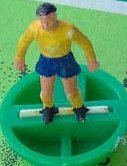
- I even own a outfield "wide
shorts" player painted into this set, who wears a yellow shirt and blue
shorts. However, this isn't unique, as the above picture of his "twin" was sent to me
a few years back (as shown).
- I also own a dark skinned diving keeper in one of my sets.
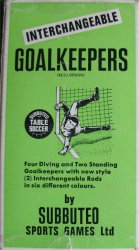
- Box types (original) :- The classic early 1970s box at the top of
this section existed right through the 1970s, and there does not seem to be
a hobby crest version.
- There are a few boxes where the word "interchangable"
appears on a white background. This might be the first edition.
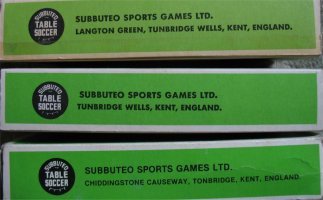
- Early sets had the Langton Green address. This was later shortened to a
simple Tunbridge Wells address, while the final versions see the factory
address at Chiddingstone Causeway used.
...With Jockey Caps (1978).
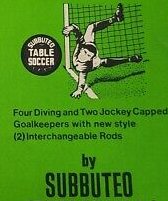
The popular C153: Goalkeepers with jockey caps arrived in 1978,
and Subbuteo Sports Games immediately added them to the C133 selection at the
expense of the disliked crouching goalkeeper
(C105). I had assumed that the first box to register this change was the
monochrome logo version from 1981, but in fact the old reliable interchangeable
box was rewritten to announce their arrival in 1978.
- May 2023: I own quite a number of these popular sets,
so I was astonished when Ashley Hemming sent me the photos of this variation
in 2023 (he'd owned the set for a long time, but not really paid attention
to it). It shows the worth of just double-checking everything in your
collection now and again.
- On this new set the text stating "six different colours" has
been dropped, acknowledging the fact that this didn't always happen, but
also the fact that the capped goalkeepers are always in yellow and (sky)
blue shirts, and these colours are often repeated in the diving 'keepers.
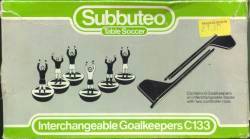
By the time of the monochrome logo boxes, the four diving
'keepers had been replaced with their modern version, which when added to the two with
caps noticeably turned this into a lightweight selection. You may have spotted
in my scan of the contents, that the yellow capped goalie is backwards
on his base. I used him a great deal as a kid - he was brilliant ;-). The set continued into
the "61" range, but had left the range by 1986.
- Box types (1980s):- The set was re-boxed in the monochrome-logo era of 1981-83, and that box
is shown here. This was the lightweight set, with two capped goalkeepers.
The set existed as 61133 in 1984-85, and this was sold as a bubble-card.
This was a shame really, because fragile goalkeepers benefit from the
protection of a proper box.
- June 2021: The 61133 bubble card is now illustrated thanks to Karl
Warelow. Note that the goalkeepers are identical colours to the early 1980s
version.
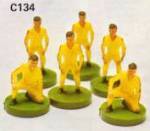
C134: Six Ball Boys.
Four
standing and two kneeling 00 scale ball boys, hand-painted in yellow tracksuits.
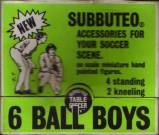
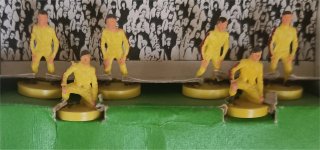
The first new set of "stand around the pitch"
(TM!) figures since C114. A nice simple addition
to the range, they arrived in 1973
and refused to go away, staying on this number until 1986, before switching to the
combined set of
61214, which in turn became
61239 in 1996 (when the bench set was added to it). In addition to these two
sets, the ball boys appeared in one of the matchday sets in 1981-82 (C187/3).
In all this time, the ball boys were produced in a yellow plastic with painted
red trim to the sleeves. In some of the early sets the bases are unpainted, but
these are usually done in the standard Subbuteo green. The lovely early display box shown above is another scan by Joe Butt.
Colour Variations.
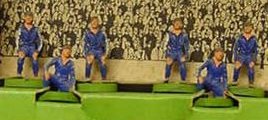
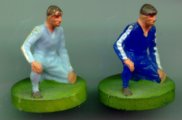
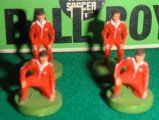
Literally millions of ball boys in yellow tracksuits with red trim
must have been produced, so it is a great relief to find them in different colours.
The royal blue set above comes from Italy, and shows the inside of the display box
pictured above. The second picture is a close-up of the crouching ball boy in light
blue and royal blue. Like the track-suited team (C103)
the colour of the plastic becomes the colour of the outfit. The last picture shows
another Italian item. This time the ball boys are in red, completing the four colours
also used for the track-suited teams. Many thanks to Francesco Disabato for this
red version.
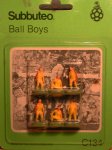
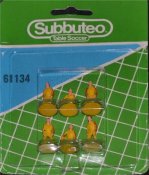
- Pack types:- The lovely mid-1970s illustrated box sadly gave way
to a stapled bag by the time I was playing in the late 1970s. They moved onto
a bubble pack in the 1980s, and the 1986 end date means that all three
bubble packs being used. The first and third types are illustrated here.
C135: VIP Presentation Set.
Five 00 scale hand-painted figures of VIP's with miniature cup.
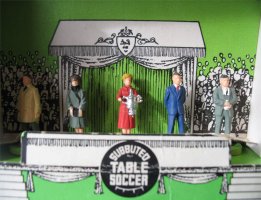
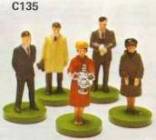
This was the final new set of 1973/4, but sadly didn't prove as durable
as the ball boys, retiring from the range in 1981. I'm not sure why this was, as they were a well designed,
and useful
"stand around the pitch" group of figures, and the original presentation box was
a beauty.
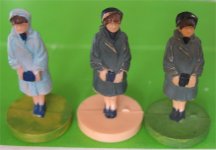
The figure holding the FA Cup is clearly the Queen, thanks to
Charles Stadden's beautiful model work. Even at OO scale, he managed to get her
side profile to match the stamps and coins of the period. The FA Cup has
traditionally been handed over by royalty, and the Queen was regularly on the
rota in the early years of her reign. I think she managed to clock up double
figures before she gave up the role in the mid 1970s (her last regular
appearance being 1976). Looking online at the Queen's cup presentations in a
variety of impressive hats, another reason why this figure is so recognisably
the Queen becomes apparent. It is clear that Stadden actually based her outfit
on the most famous cup presentation she was involved in - giving the Jules Rimet
trophy to Bobby Moore at the 1966 World Cup. Although Subbuteo have tweaked the
colours, both the hat and coat/dress are a great match.
This information then leads to speculation over who the other
figures represented. I haven't seen the Charles Stadden invoices for the period,
so I don't know if he named checked anyone! As a kid, I always regarded the chap
in the blue suit at the Duke of Edinburgh, and that seems certain. His stance
matches the 1966 presentation photos, and his nose is quite distinctive even in
Subbuteo scale. In the 1966 photos, FIFA President Sir Stanley Rous is standing
between the royal couple clutching a medal, and the chap with the fuller figure
and the grey suit seems to be a good match - albeit that Subbuteo decided to
give him a full head of black hair. I would admit though that most Cup
presentations of the period seem to contain a well-fed older suit from the FA or
similar organisation. After this, the 1966 connection seems to break down. The
second lady looks distinctive enough, but she doesn't look like the Queen Mum.
There are certain 1966 photographs where you can see a lady in a sky blue dress standing a row
back, and the next person on the balcony is the sport-loving Duchess of Kent.
Not sure if she is either of these ladies though.
The final chap appears to be a little mismatched. With his coat
and hat, he looks like someone who is working, rather than someone in a royal
box - like a manager, or a journalist, or perhaps the Queen's racehorse trainer
giving her a tip... Actually, the coat and the hat made me think of a famous FA
Cup winner of the period. The figure is a great match for Joe Mercer, whose
Manchester City side won the FA Cup in 1969. There are plenty of photos of
Mercer on the day, wearing this outfit. Disappointingly, the Queen wasn't presenting the
cup that afternoon. It was a very young Princess Anne (check out her hat online.
She looks like she has just ridden in).
Sadly, the set did not keep the useful presentation box, and it was
later dumped into a bag, and then a standard bubble pack (which is how I bought
my set when I was a kid). Of course, the little FA cup in this set is the only trophy that
is the correct size for a Subbuteo player. Instead of sitting one of your players
in the top of the FA cup, they could now run around with it stuck on their arm.
Hurrah.
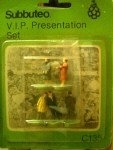
- Pack types:- As with the ball boys, the attractive display box was
replaced by a bag with header card by the late 1970s. The set was then packed
onto the original bubble card, but as its last appearance was 1980 it probably
did not make the other card backs.
- The set cost the princely (Queenly?) sum of 25p on introduction, and
this had
risen to 95p by the final appearance in 1980. Inflation huh, what happened
to that? Oh.
- The only significant colour variation to this set is with the
second woman, who has a quick dress change from pale blue, to drab grey. The
sky blue is prettier, but you can see the flesh plastic through it, so
perhaps that caused the change.
- Like the ball boys, you also can get sets where the base has not been painted to a green
grass colour. This makes more sense for the figures in the presentation box
as they are not supposed to be standing on the pitch...
- The VIPs are not as common as many of the other accessory figures,
although the set sold though Subbuteo's golden period of the 1970s, so they
are readily available. However, the tiny FA Cup was very easily damaged or
lost (especially if your players were running around with it stuck on their
arm - sigh). So sets with the cup intact command a premium. Make sure you
get one.
C136: The Subbuteo Sound.
A record of the Subbuteo World Cup song and other thrilling sounds
of real-life international football.
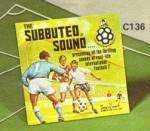
After using all their good ideas in the six new items in 1972-74, this was what
they came up with the next year. Oh dear - the words "introduced 1974-75 - dropped
1977" say it all really. The record is actually copyright 1973, and was made by
Lyntone Ltd who used to press all sorts of odd tie-in and advertising-related records
(usually flexi discs). The first side is about five minutes in length, with the
second side slightly longer. The record is set out like an important match. The
first side starts with the Wadhurst School Silver Band playing marching music, and
this leads into the Subbuteo World Cup song. This is sung by the Subbuteo Games
workers to the tune of "she'll be coming round the mountains", mentions going to
the Munich Subbuteo World Series in the lyrics, and has a horrible catchy "Ho Ho
Ho Subbuteo" chorus. You'll be humming it for weeks. I guess it's authentic in that
all World Cup songs are pretty cheesy. Then there's a posh old BBC type announcer
welcoming the teams onto the pitch, before the record settles down into the crowd
sounds that fill up the remaining length. The crowd noise rises and falls as the
game progresses, and there are whistles, and the thumps of goal kicks to add to
the atmosphere. As it's a kids game, the crowd are very polite, and applaud rather
sweetly. I only detected one burst of booing !! There are also some crowd chants
sung by the Subbuteo workers, which seem to be pasted in. Many of these have aged
terribly. "Nice one Cyril" anyone? The second side finishes with the announcer summing
up the match - which is pretty tricky when he doesn't know what happened.
Actually, one of my Subbuteo playing friends had a record in the 1970's of crowd
sounds/singing from Anfield. We never thought of using it as a Subbuteo backdrop, but
I think it might have actually worked. Nowadays, you wouldn't be able to sell a
record of crowd chants to minors - without bleeping most of it out. Cool. Thanks
to Chris Smith for providing a copy of the record, and Dave Noades for further information.
C137: Subbuteo Badge.
An iron-on Subbuteo Badge.
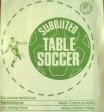
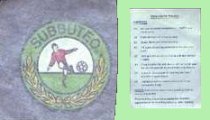
Another uninspired 1974/75 addition, this item allows you to add
the 1970s Subbuteo logo to a t-shirt - thus ruining your cool for all time.
Survived to 1980, but gone from the 1981 lists. It matches the other short lived badge Set BB, and
car sticker, Set C116 as a long forgotten promotional item. Two iron-on badges are
now illustrated, the second one is a spanking colour badge (complete with instructions).
However, it's the green and white one that gets its only catalogue illustration
(in 1980). Still not as good as the Next t-shirts produced in the 2000s...
C138: England Team.
An OO scale England team... supplied in special team holder box.
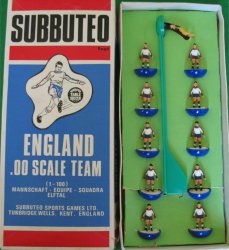


It seems like quite a good idea to produce a separate England team.
If nothing else, it made it easier to locate this popular kit within the range. I guess the reason
it was produced was to cash in on the new and swanky 1970s England kit with the
blue and red sleeve trim, as produced by classic 1970s manufacturer Admiral. After all, England kits before this date were pretty uninspired,
simply white with dark blue shorts (okay, this is a classic, but it was shared
with Bolton Wanderers and others). Until this date, Subbuteo had seemed content
to leave England in their World Cup team range. Come to think of it, the World
Cup teams swap to the standard range around the time England failed to qualify
for the 1974 World Cup - a result which would have left a unique England team in no range at all....
But I digress. This new England team arrived in 1975, in the
final years of the big box era. So this was a long box with a card interior.
However, instead of a standard green box it was produced in appropriate colours
with the England kit reproduced on the kicking player on the lid. The box end
advised that this was C138. This was the only coloured box that Subbuteo
produced for the UK market in the long box era, but Edilio Parodi in Italy obviously
approved as he had the C100s range produced. That range put a number of Italian club
sides and more national teams in similar colourful boxes. Perhaps it was only cost that
prevented Subbuteo in the UK from doing the same thing.
The
set only appeared in one catalogue (and two price lists 1975 and 1976). Team boxes were reduced in size in 1977 and Subbuteo,
obviously still toying with the format, produced
C500 instead. That
later set had special coloured team boxes designed like this one, but in the smaller size
(with plastic inner), and
this time they covered all four home nations. After that, there was a Home Countries Pack (C165)
containing the four sides in the single player window boxes in a wrapper, but by
1981 they were all back in the normal C100 range again.
- An England away kit was also produced as C500, and I've been told that
an away version of C137 was also produced. I've seen the odd one, but the
box is identical, and the away kit produced separately, so it is easy to
replicate.
- The goalkeeper in this set should be in England colours - yellow shirt,
black shorts with yellow trim and black socks. It can be a straight diving 'keeper or the
diving back version. The goalkeeper is shared with the C500 version, and
occasionally break out into the standard C100 version (reference 317). So
not too difficult to replace if you have a broken one.
-
Hasbro had a final attempt at a unique England box with accessory item 61246
in 1997.
C139: Trainers Bench Set.
Six
figures consisting of Manager, Trainers, and Reserves to seat inside the new modern,
covered, all-weather bench. Reserves have red, or blue tracksuits.
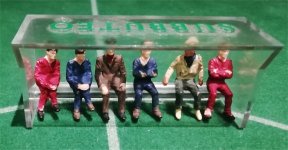
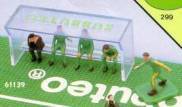
Introduced in 1976 to
replace C114, this featured the
classic clear plastic bench for the first time. It also saw the end of the forgotten
Ken Baily mascot. In the early sets, there were a couple of grumpy looking cloth
capped folk and the reserves from C114. These reserves tended to be painted in
red or blue. Later versions had redesigned reserves,
a manager with his head in his hands, and one separate exercising substitute on
his own base. In the later set, the plastic, and therefore the tracksuits, was usually
green. This later version was also available in a two bench set, with one group
in blue, and the other in red (C179).
It also reappeared in the Match Day series of 1981-82(C187/2),
and after being produced right through to 1995, the set was finally merged with
the other remaining "stand around the pitch" sets to become part of the Stadium
Services Pack (61239).
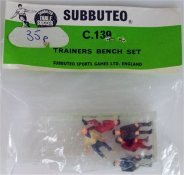
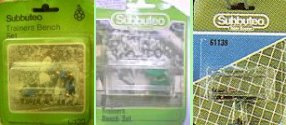
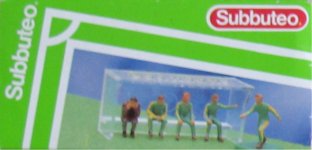
- The original bench can have tracksuits in red or blue (and sometimes both!)
painted onto flesh plastic figures.
- Pack types:-
The bench was originally sold in a bag, with header card. It then switched to
a bubble pack, being sold through all three card types. Finally, it was boxed
in the standard size pitch-corner box.
- In the versions shown, you can see the old blue
tracksuits in the original bubble pack, but the other two packs are green.
You've reached another break in the list. If you want to go lie
down at this point, that's fine :-). Otherwise you can carry on to C140, which is
the icing on the 1970's Subbuteo cake. Err... It's the Grandstand.
[ Main Page
| Previous Page
| Next Page
]