| Peter Upton's |
|
Subbuteo Tribute Website. |
|
Miscellaneous Items |
|
Shop Displays. |
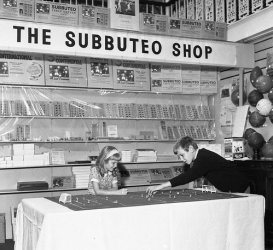
One of the most sought after items for many collectors, especially in the world of toys, is a shop display. The main appeal is the chance to recreate the joy of a probably long lost local toyshop (or sports shop, as was often the case with Subbuteo). That's surely better than recreating the squalid condition that old toys had to suffer in your bedroom....
There is obviously a rarity value to factor in as well. Subbuteo was mass produced, and even relatively poorly selling items were produced in sizable numbers. On the other hand, the shop display was limited to one per store, and many stores did not use the official stands anyway. I cannot think of too many in my area that did.
So this page is a celebration of trade stands and displays. Obviously, it needs a bit more detail, so if anyone has pictures of their local shop, or other stands, then please send them in.
1970s: Single Figure Team Displays.
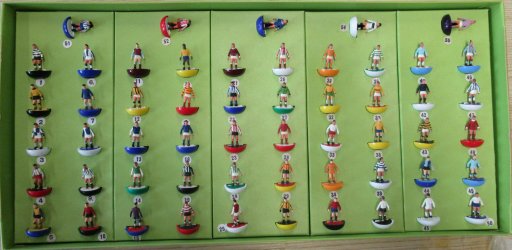
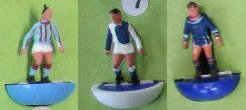
What is cooler than having a wall chart with pictures of all the available teams on it? How about owning the real thing?
The team boxes from the 1970s were ideally designed for simply stacking on a toy shop shelf, with the numbered ends outward. So no real display stand was needed. However, this did not show off the actual teams, and often a shop would not be able to stock the whole range anyway. So what better way to produce extra sales than one of these beauties for little boys to gape at?
Shown above is the earliest single figure display that has yet been sighted. This has five trays, displaying a team range of 55, which dates it to around 1968-69, very early in the era of the classic heavyweight. Please note that the teams are not in the correct places in this picture (this is what happens when you borrow pictures from the internet!). In this version of the set, the players are displayed in the standard team box interiors of the era.
Things to note about this team range.
This second display shows the expanded range up to FC Subbuteo at ref 60, plus the World Cup 1970 teams, which date it to around 1969-70. This means no room for the nameless original ref 61, which was red and black stripes. Although the picture I have isn't very clear, it appears that the ref 23 is still in those colours in this display anyway. This is the earliest display to feature inserts that were the green versions of the fifteen man rugby box.
Each team was identified by one of the little number circles from the box ends, except for the World Cup teams. these were identified by name, typed onto either the green insert or a white label. There were sixteen World Cup 1970 teams, but luckily, Brazil were already in the normal range, and this allowed the use of a single tray for this range.
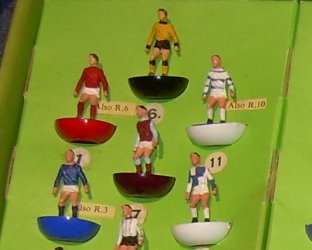
A five tray display piece has also been sighted simply hosting teams 1-75 with no World Cup sides, which would match the 1970-71 catalogue. Interestingly, this second set also had typed stickers advertising the rugby versions of several of the kits. In the 1970-71 catalogue are a few quirky team colour descriptions - ref 26 with blue shorts, ref 32 with black shorts, and the tangerine version of ref 47. However, once again none of this are reflected in this display case.
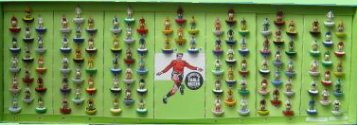
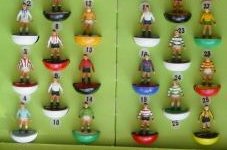
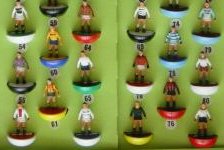
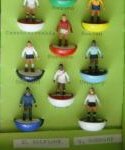
Here we move onto a seven tray version of the team display, housed in a beautiful long green tray with Subbuteo Table Soccer, and the 1970s "ball" logo running down the sides. The trays here slot in with a surround to hold them in place, but this leaves the top figure projecting rather oddly over the ledge. The display a shows the classic 1-81 plus World Cup range, which ties to the 1971-72 range.
Other than that, the range is notable for the absence of the strange anomalies found in early 1970s catalogues. Once again, quirky versions like amber shorts on 46, the tangerine 47, and black shorts on 32 all appear in the 1972 catalogue, but all are absent here. This might help to explain why these sides go back to the classic versions once the illustrated catalogues start in 1973. Perhaps the quirks were errors in the catalogue, or simply never established themselves across the whole figure painting business.
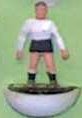
I've seen pictures of a further version of the seven tray display, which completely matched the variations (or lack of) mentioned above, although the players were in the wrong places. However, there was one strange anomaly - ref 10 was painted onto a rugby player.
Subbuteo continued to make these displays as the range increased. I've seen the 1-106 (+ World Cup sides) range of 1972-73, and I believe that 1-190 was also done, although I don't seem to be able to find a picture of these items yet (if you own one, send a picture in).
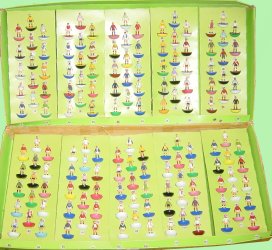
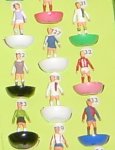
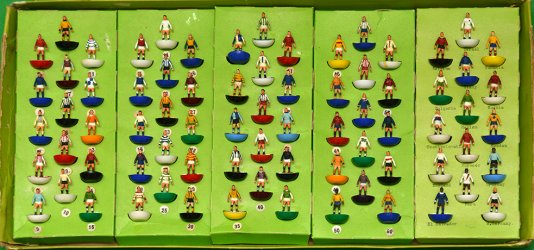
Here's another interesting shop display. This time the teams are 1-150, without the World Cup sides. This does not actually match to a specific catalogue year, as the teams increase from 106 in 1972-73 to 165 in 1973-74. So I suppose the size of the box determined how many teams would be displayed.
This display still belongs to the son of the original toy shop owner. He was allowed to keep one item when the toy shop closed, and chose this. Good work! As photographed for the site, a good few of the players are in the wrong positions, but this "straight from the loft" condition adds to the charm. The teams, as usual, seem to straddle their accepted catalogued dates. The "proper" claret ref 61 is now in place, but the ref 79 (West Ham 2nd) still has white shorts. The close-up reveals the most interesting player in the whole box - a reference 123 in the non-catalogued "mauve" shorts variation. The odd looking team on ref 133 in this illustration is a badly painted ref 83, in case you were wondering.
German Team Displays.
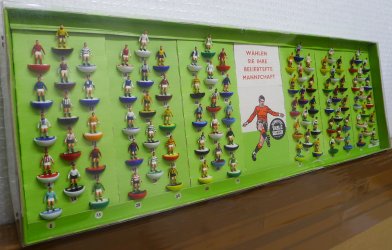
A big thank you to Stefan Sandner, an Austrian collector, who sent in the pictures of this German shop display. It is the usual seven tray display, although the middle tray has no players in it.
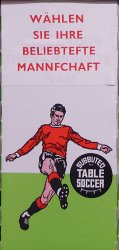
Stefan helpfully tells us - "the text is the German translation of „select your own favourite team“. you can still see the English version being printed underneath. the funny lispingly „beliebtefte mannfchaft“ should be „beliebteste mannschaft“ correctly. the display features refs 1-75, plus 76 (Eintracht Frankfurt) in the last tray, additionally the German sides 127- 134 (a German rules booklet from the earlier 70s shows exactly the same list), and 6 rather strangely(?) selected national/world cup teams (Czechoslovakia, England, Italy, Russia, Sweden, West Germany)."
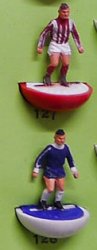
I've shown close-ups of 127 and 128 to show the painting style on these teams. The four stripes on the 127 are clearly done in two different sizes, making it look different than usual. The 128 has a white stripe painted on a blue sleeve, which is how it looks on the 1970s posters, but teams in collecting circles are often the other way around (a blue stripe on a bare white plastic sleeve...).
Other than that, the teams are the standard catalogue versions - although it should be noted for the record that ref 20 has black shorts, and ref 24 has white.
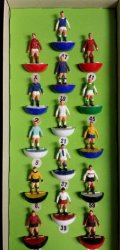
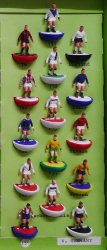
The final picture from Stefan comes from a single tray display, of which the seller had several (were they giveaways?). The teams in the single tray were taken from the 1-76 range, and feature teams in the Bundersliga, as highlighted in the early 1970s German catalogue. These must be a little earlier in date than the display, as Subbuteo were using ref 59 as Stuttgart, and 21 as 'Gladbach. It's worth noting that a some of the sides that were unusual in the UK in the 1970s (17, 59 and especially 37) were in the key range in Germany.
| 01 | FC Koln |
| 02 | FC Schalke 04 |
| 05 | TSV Munchen 1860 |
| 06 | Borussia Dortmund |
| 14 | Hannover 96, FC Nurnberg, etc. |
| 17 | Karlsruher SC |
| 19 | FC Bayern Munchen |
| 21 | Borrussia Monchengladbach |
| 37 | BSC Hertha Berlin |
| 39 | Hamburger SV, Fortuna Dusseldorf, etc. |
| 41 | 1. FC Kaiserslautern |
| 45 | Werder Bremen |
| 47 | Eintracht Braunschweig |
| 59 | VfB Stuttgart |
| 76 | Eintracht Frankfurt |
The Rugby Team Display.
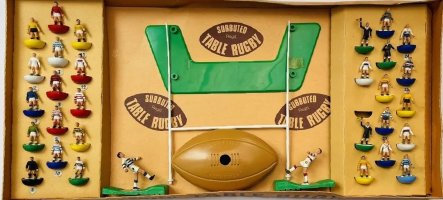
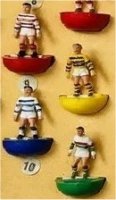
Subbuteo also produced this simple rugby team display featuring two box inners, plus a specially printed backing card. As two boxes give space for 30 players, but there were only 26 teams in the early 1970s rugby range, the extra slots were taken up with the referee and linesmen (and here an extra R1 Australia seems to have snuck in). The highlighted close-up shows the single hoop variation on R9, and the only heavyweight player in the selection R15 Plymouth Albion. There is a nice selection of white based variants, which cuts down a little on the number of teams in blue bases. (the problem of one colour bases is highlighted though - too many colour clashes).
The inner space is used to highlight the distinctive parts of the rugby game, in the Scrummer, the kickers, and the goal posts. All very enticing to the prospective buyer...
1968-69 Accessories Shop Display.
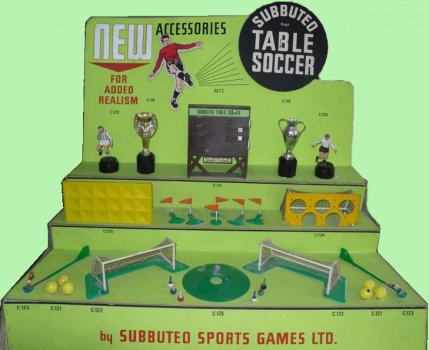
This stunning item is a shop display for the new accessories that were produced at the beginning of the Waddingtons ownership era in the late 1960s. It is one of those things that you have to marvel at how they have managed to survive for 45 years. The stepped stand in classic Subbuteo green was designed to show off Continental accessories C117 to C126, plus the redesigned scoreboard that was still being sold as Set Z.
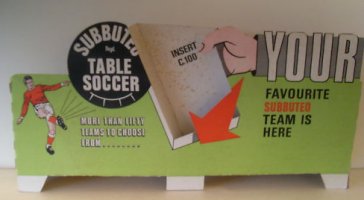
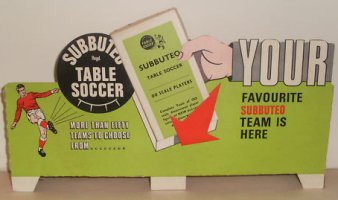
Now this is another really lovely cardboard window display. It is designed simply to hold one team box, which I suppose could have the lid on (as illustrated), or perhaps revealing the team inside. The team box fits into a suitable slot (shown here both empty and filled). A nice touch is that the thumb of the hand goes in front of the team. A neat way to show window shoppers that the colours of their local side were available.
The date of the piece (circa 1969-71) can be gathered from the kicking footballer logo (in the colours of the 1970-71 catalogue), and the wording ("more than fifty teams to choose from....").
This type of quirky promotional material don't tend to be kept by shops, so it's a great thing to see survive.
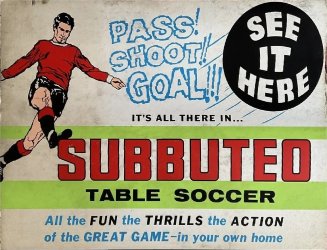
This item is another old cardboard shop window display, but this is just a simple two dimensional item. It looks as if it is from a similar era to the previous model. Once again, the logo is from the 1970-71 catalogue and was first used in the late 1960s. The Subbuteo logo looks as if it comes from an earlier era, and the undated advertising leaflet that uses it features the original short-sleeved heavyweights. However, Advanced Rule books featuring the same picture last until the 1969-70 season, and the prices/details of the sets on my version match to 1968-69.
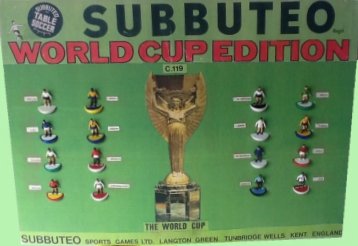
I was sent this picture before the website took a break, and it has since reappeared on the Subbuteo Online site. This particular stand was apparently used at the 1970 Subbuteo World Cup, staged on 22-23 August 1970 at the Savoy Hotel in London. (although they did not call it a Subbuteo World Cup at the time)*. It is actually a lovely advert for the Subbuteo World Cup Edition (new to the range), and the updated "named box" teams sold for the 1970 tournament. The most interesting thing about it is that the Morocco player has been painted with the dark skin tone, which wasn't used in the retail product (see Black players in Subbuteo for more on skin tones). It is also worth noting that England and Russia are represented by moulded box set teams. This makes some sense for Russia, as the socks are correct compared to reference 1. Also Israel is just a standard reference 21 (no badge).
*NOTE: Similar 1966 stands have surfaced, and all have this rather unsatisfactory "cut and paste" quality to the writing and details, and strange anomalies to the player figures (especially the rarer teams). Sadly, it is possible that the board is not genuine, and that might explain the strange anomalies mentioned on the rarer figures.
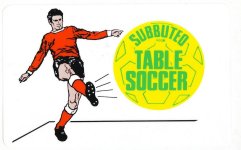
Another interesting item that has turned up a couple of times is this window sticker, designed to be displayed on the inside of the glass.
Moving rapidly into the 1980s, and we find that Subbuteo Sports Games obvious love of paperwork once again provides useful information. These display stands were offered in Subbuteo's trade catalogues, produced at a time when retail customers had to make do with posters.
1982-83 Display Stand.
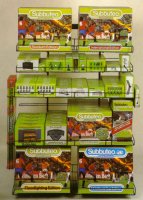
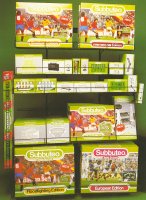
This was a large free standing black metal unit, which held an impressive amount of Subbuteo. As the trade catalogue put it, this "carries boxes of all sizes, even the awkward ones for goalkeepers and astropitch" both of which hang off the sides.
Almost as interesting as the display is the chance to see the shop range for these years in the monochrome accessory boxes. I liked these boxes as a kid, but they had quite a short life, and do not turn up as often as other ranges. It's certainly interesting to note that both the floodlights and Grandstand moved from their attractive colour boxes into monochrome in 1983, and the pitch also started to be boxed at that time. Note also that the colour of the illustration on the corner stand box changed from black to white. The FA Cup and League Cup also switched from Hobby Crest boxes in 1982 to monochrome logos in 1983.
1982-83 Counter Spinner.
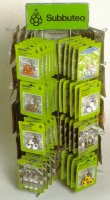
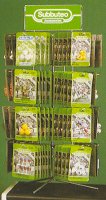
The lovely counter displays for blister packs show the change from hobby crest to monochrome logo even more clearly. The backing picture also changes on the cards, matched to the picture on the club edition.
1984 Stand.
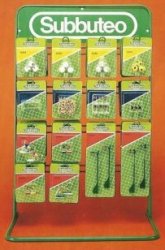
The 1984 trade catalogue showed a new display stand for the newly renumbered 61xxx bubble packs. The range had been reduced so the smaller blister pack display no longer had to rotate.
The new flat version also saw the arrival of the goalkeepers onto cards (and the cups too, although they are not shown here). The blisters were colour coded, with yellow for balls, red for playing accessories, blue for stadium accessories and lilac for the cups. I never noticed this at the time, and I guess it was because all the items were very self-evident. If you wanted a pack of balls, it wasn't difficult to pick them out whatever the colour. Still, they look nice on display don't they? The blue here is very dark, and it makes me wonder whether this picture is actually a prototype.
1985 Stands.
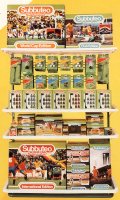
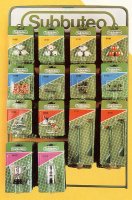
The large stand for 1985 shows a bold change in design. There are now more teams shown on the big stand, and also room for hangers. This made sense, as the accessory range was shrinking, and more items had moved onto the blister cards. Of course, all the boxes had changed once more (and the number range moved to the 61xxx version). The small stand had been introduced the previous year, but here the Subbuteo logo at the top has the colours reversed. In addition, the cups have now arrived on bubble cards.
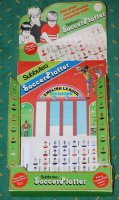
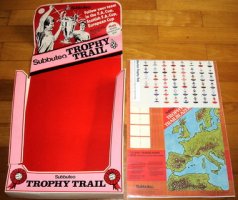
Here are a couple more simple pieces of shop display material. These are the counter display boxes for Subbuteo's Soccer Plotter and Trophy Trail. The Soccer Plotter was C160 in the accessory range, introduced in 1979. It was a simple league ladders poster featuring the four English divisions with clubs and colours shown on reusable stickers. Despite the more boring monochrome display box, the Trophy Trail (C176) was introduced a year later, and allowed a more generic cup competition to be shown. Neither item made it into the 1981 catalogue, although I think they hung around (unsold!) for longer than that....
The Italia 1990 Stand (from an Italian Trade catalogue).
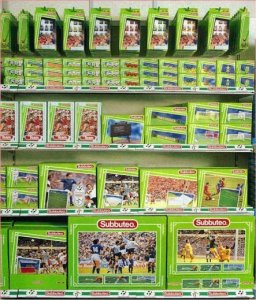
This picture from a trade catalogue was shown under the Italia 90 banners, and shows a fully stocked Subbuteo shelving unit, which looks suspiciously like the "Goal Stand" which is shown in all its glory below. However, this one does feature Subbuteo logos to the fronts of the shelves, and is stocked with a range tied to the correct era. That means the video cassette style Super Team boxes are in decent supply, along with Italia 90 goals and pitches. When videotapes were the future (and digital watches were still a pretty neat idea*).
*A little bit of Douglas Adams that has aged beautifully.
1990s: The Goal Stand.
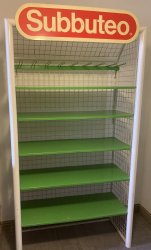
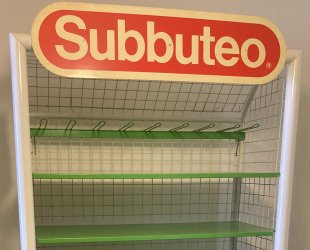
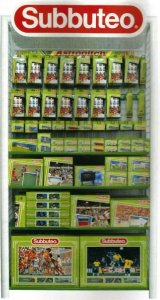
October 2020: Finally pictured on the site. I remember one of these by the door at one of my favourite toy shops (in Horsham, West Sussex), and amazingly, a fully loaded one did turn up on ebay years ago. Obviously, the ebay one was not travelling by post (airmail to Italy sir?) Alas, I lost the picture in a computer crash, so step forward Peter Winstanley, the lucky owner of this big and beautiful metal beast. Of course, even the teams were on hangers by then. Who remembers having to tilt their body/head at ridiculous angles to read the names on teams at the back of the display? No wonder the boxes got damaged.
April 2024: A trade catalogue picture has surfaced of a fully loaded goal stand, showing lots of Subbuteo goodness from around 1992-93. Although I've had to reduce the size of the picture somewhat, hopefully you can see why I had so much trouble trying to identify the teams on the backs of the hangers. And what is that Astropitch sitting on? The hangers?
2000s Parodi Team Stand.
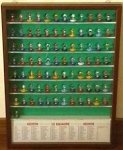
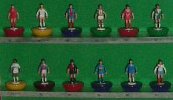
I've been sent pictures of this stand twice, but I don't know whether its use was widespread (the pictures could even be of the same one....) This is an Italian stand that harks back to the glory days of the 1970s with one player from each team currently available displayed on thin shelves. However, the range here is the Hasbro teams Parodi offered in their re-launched catalogue circa 2001. Essentially, this was the unsold stock from the 1990s "European range". It's such a lovely wooden case, that it does look more like something a collector would build rather than a manufacturer.
Sadly, that's all the information I've got at present. So it's time to pick another destination.